

Europe Strengthens Border Security: What the New €130 Million Funding Means for Travelers
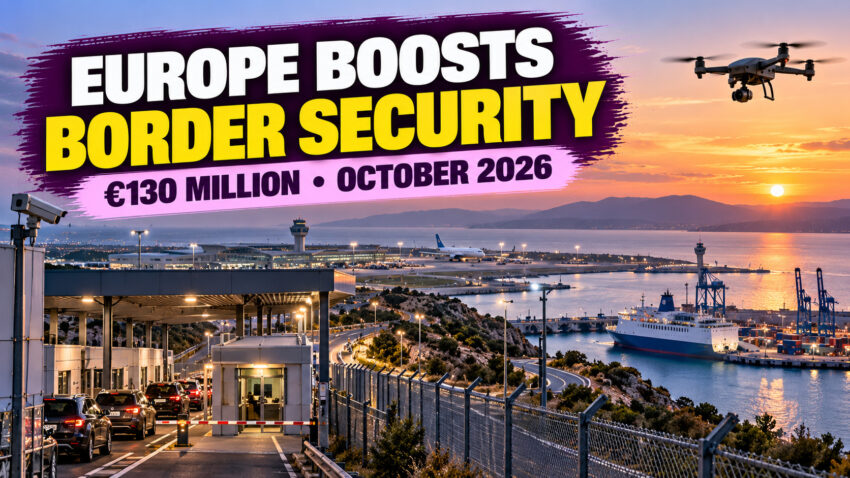
The European Union is increasing its investment in border security, with an additional €130 million allocated to drone and counter-drone technology. Announced by the European Commission in October 2026, the funding is intended to help national authorities monitor Europe’s external borders and respond to emerging security threats.
The initiative covers selected EU member states and Norway, a country associated with the Schengen Area. It forms part of the EU’s wider effort to strengthen surveillance and improve coordination between national authorities.
But what does this announcement mean for tourists, international students, workers, and people planning to visit Europe? Here’s what travelers should know.
What Is the EU’s New €130 Million Border Security Fund?
On October 13, 2026, the European Commission confirmed an additional €130 million under the Border Management and Visa Instrument (BMVI).
The funding will support drone surveillance, counter-drone measures, information technology, training, and the integration of new systems into national border-management frameworks.
The objective is to help authorities identify unauthorized or potentially hostile drone activity, improve their understanding of incidents near borders, and respond more effectively to security threats.
The investment builds on earlier funding announced in December 2025 and additional support made available in 2026. Together, the allocations for surveillance and counter-drone technology under EU Home Affairs funding exceed €500 million. <Cite refs={[“turn745895search0″,”turn745895search1”]}/>
Which European Countries Will Receive Support?
The new funding will support authorities in 16 EU member states and one Schengen-associated country.
The participating EU countries are:
- Bulgaria
- Croatia
- Cyprus
- Estonia
- Finland
- France
- Germany
- Greece
- Hungary
- Italy
- Latvia
- Lithuania
- Poland
- Romania
- Spain
- The Netherlands
Norway is also included as a Schengen-associated country. <Cite refs={[“turn745895search0”]}/>
The funding is intended to strengthen border-management capabilities across different geographical areas, including land borders, maritime borders, ports, airports, and border crossing points.
The European Commission has not published a detailed country-by-country breakdown of the new €130 million allocation in its announcement. It is therefore not possible to confirm how much each participating country will receive.
Why Is the EU Investing in Drone Technology?
Drones can provide aerial views of areas that may be difficult to monitor using conventional methods alone. They can help authorities observe activity around border regions and identify situations that require further investigation.
Counter-drone systems, meanwhile, are intended to help authorities detect, track, and respond to unauthorized or potentially dangerous drone activity.
The EU’s investment focuses on three main objectives:
1. Improving Border Surveillance
Aerial surveillance can help national authorities monitor land and maritime border areas, including locations where traditional monitoring may be challenging.
2. Detecting Security Threats
Drone and counter-drone systems can support the detection of unauthorized activity and help authorities assess potential risks.
3. Improving Coordination
The funding can also support information technology, staff training, and the integration of surveillance systems into national frameworks. This can help relevant authorities share information and coordinate their responses.
These measures are intended to improve security at Europe’s external borders. They do not establish a single surveillance system operated identically by every European country. <Cite refs={[“turn745895search0″,”turn745895search1”]}/>
Does This Mean Europe Is Introducing New Border Checks?
Not automatically.
The €130 million announcement concerns investment in border-security technology. It does not, by itself, introduce a new visa requirement, change the Schengen visa application process, or announce new checks for every traveler.
Individual countries may operate border checks according to their applicable laws and security arrangements. Travelers should therefore distinguish between investment in security equipment and a formal change to entry requirements.
If you are planning to travel across Europe, check the current guidance for your destination and any countries you will transit through.
Will the New Funding Affect Tourists Visiting Europe?
For most tourists, the funding announcement does not require an immediate change to travel plans.
However, stronger monitoring and security capabilities may influence how authorities manage border areas and respond to potential incidents.
Travelers should continue to:
- Carry a valid passport and any required visa.
- Check the entry requirements for their destination.
- Keep accommodation and return or onward travel information accessible when relevant.
- Follow instructions from border officers and airport staff.
- Check for temporary border controls before crossing between Schengen countries.
The investment is focused on strengthening the capabilities of authorities. It does not guarantee faster border processing, and the Commission has not announced that the funding will shorten airport queues.
What Should Pakistani Travelers Know?
For Pakistani citizens planning to visit Europe, the most important point is that the new border-security funding does not change visa eligibility by itself.
Pakistani ordinary passport holders generally need a visa to visit Schengen countries for short stays, subject to the applicable rules and any relevant exceptions.
Before applying, travelers should:
- Identify the correct country and visa category for their trip.
- Check the destination country’s official visa guidance.
- Prepare the required supporting documents.
- Allow sufficient time for the application process.
- Check for current entry conditions and temporary border controls before departure.
A stronger border-security system does not mean that visas are automatically harder to obtain, nor does it guarantee that applications will be processed faster. Visa decisions continue to depend on the applicable rules and the individual application.
Does the Funding Affect International Students and Workers?
The announcement does not create new student visa or work permit requirements.
International students should continue to follow the residence and visa rules of the country where they intend to study. Similarly, workers must obtain the relevant authorization for their employment and destination.
People moving between European countries should not assume that permission to live or work in one country automatically grants the same rights in another. Requirements depend on nationality, residence status, and the rules of the destination country.
For anyone planning a longer stay, checking the official immigration authority’s guidance remains essential.
How Long Will the New Funding Be Available?
The European Commission states that the selected projects will be integrated into national programmes under the Border Management and Visa Instrument. Funding is available for implementation during the current programming period, with support available until December 31, 2029. <Cite refs={[“turn745895search0”]}/>
The announcement does not provide a complete list of the equipment that each country will purchase, the precise location of every installation, or a schedule for individual projects.
Implementation will therefore depend on national programmes and the projects selected by the participating authorities.
What Does This Mean for the Future of European Travel?
Europe’s investment reflects the growing role of technology in border management. Aerial surveillance and counter-drone capabilities may help authorities monitor external borders and respond to emerging security concerns.
For travelers, however, the practical effect will depend on how individual countries implement their projects. The funding should not be interpreted as a general change to European visa policy or a guarantee of faster entry.
The best approach is to stay informed, prepare the correct travel documents, and check official information before departure.
Final Thoughts
The European Union’s additional €130 million investment is designed to strengthen external-border security through drone surveillance, counter-drone systems, training, and improved coordination.
The funding will support authorities in 16 EU member states and Norway, with projects expected to be integrated into national programmes.
For tourists, international students, workers, and Pakistani travelers planning a European trip, the announcement does not itself change visa requirements. Continue to check the rules for your destination, carry the required documents, and verify any temporary border controls before traveling.
Follow TravellerTrek for practical European travel news, immigration updates, and guides to help you plan your next journey.