
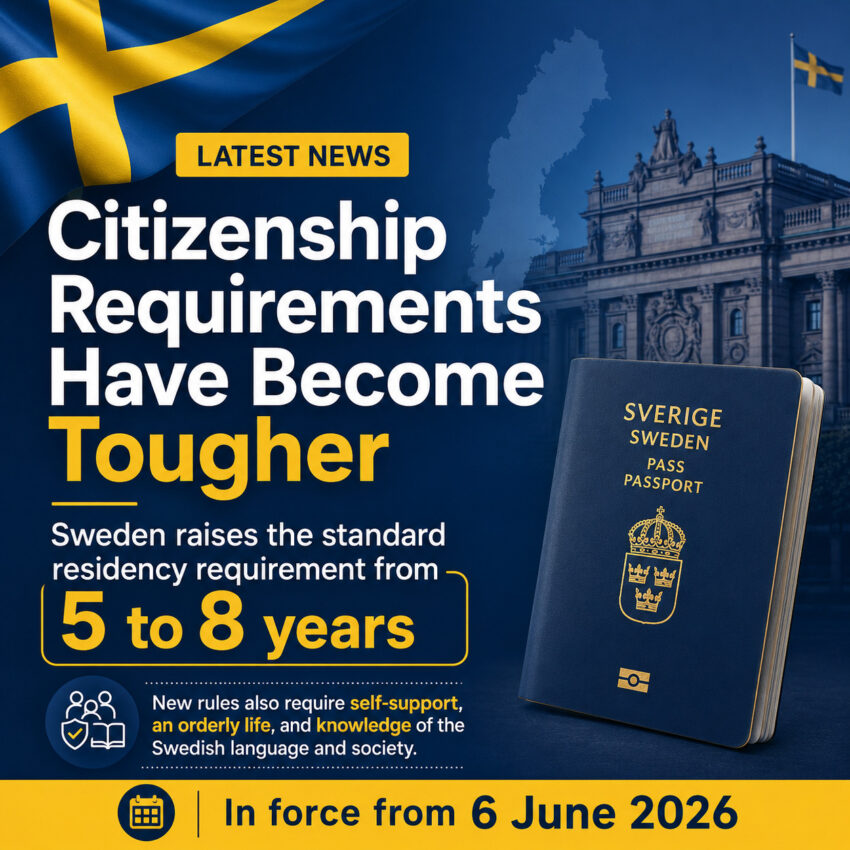

The path to Swedish citizenship has become significantly more demanding following the introduction of new citizenship rules on 6 June 2026.
The Swedish Parliament approved the changes on 29 April 2026. The reform increases the standard residence period, introduces financial self-sufficiency requirements, strengthens conduct checks and requires applicants to demonstrate knowledge of the Swedish language and Swedish society.
The new requirements apply not only to people submitting applications after 6 June but also to applications that were already pending and had not been decided before that date. There are no general transitional arrangements protecting applicants under the previous rules.
Standard Residence Requirement Increased from Five to Eight Years
One of the biggest changes is the extension of the standard habitual-residence requirement from five years to eight years.
Habitual residence generally means that a person is legally resident in Sweden and intends to remain in the country. However, not every period spent in Sweden automatically counts toward citizenship.
Time spent in Sweden with certain temporary permits—such as ordinary residence permits for studies, visits or au-pair work—normally does not count. Doctoral students may, in certain circumstances, count their study period when it is clear that they intended to remain in Sweden after completing their studies.
The eight-year rule is the main requirement, but different residence periods continue to apply to particular groups.
Nordic citizens may generally qualify after two years. Former Swedish citizens may also qualify after two years. Applicants under the age of 21 generally need seven years, stateless applicants need five years, and people with recognised refugee status generally need seven years of residence.
A spouse, registered partner or cohabiting partner of a Swedish citizen generally needs seven years of residence and must have lived with the Swedish partner during the previous five years.
Applicants should therefore avoid assuming that the date they first entered Sweden is automatically the date from which their citizenship residence period is calculated.
Applicants Must Be Financially Self-Sufficient
A new maintenance requirement means that most adult applicants must prove that they can support themselves through their own long-term income.
For 2026, the required income is at least SEK 250,200 per year before tax, equivalent to approximately SEK 20,850 per month before tax. The income must normally come from regular employment or self-employment.
Capital gains and investment income cannot normally be used to meet the maintenance requirement. Unemployment benefits, activity support, establishment allowances and income from several forms of subsidised employment also do not count.
Applicants must also not have received social assistance for more than a total of six months during the three years before the citizenship decision. Importantly, the conditions are assessed when the decision is made—not necessarily only when the application is submitted.
Certain applicants may be exempt from the maintenance requirement. These include some pensioners, people with disabilities who cannot reasonably be expected to work and students completing approved full-time programmes with satisfactory academic results at Swedish universities, higher-education institutions or qualifying vocational programmes.
Swedish Language and Society Knowledge Is Now Required
Applicants between the ages of 16 and 66 must demonstrate sufficient knowledge of the Swedish language and Swedish society.
The language standards are based on the Common European Framework of Reference for Languages. Applicants generally need:
- B1-level reading and listening comprehension
- A2-level speaking and writing skills
Language knowledge may be demonstrated through recognised Swedish school qualifications, adult-education courses, the highest level of Swedish for Immigrants, known as SFI, the Tisus test or another approved proficiency test.
Knowledge of Swedish society may be demonstrated through approved social-studies qualifications from Swedish compulsory school, upper-secondary education or municipal adult education.
Applicants unable to prove their knowledge through recognised qualifications will be given an opportunity to take a citizenship test. The Swedish-society component is expected to become available from August 2026, while the dedicated Swedish-language citizenship test is expected from autumn 2027 at the earliest. Until then, recognised qualifications and approved language tests may be used.
Some exceptions apply, including for certain people with disabilities, Nordic citizens applying through the relevant route and stateless people born in Sweden who are under 21.
Stricter Conduct and Character Checks
Applicants must demonstrate that they have lived—and can be expected to continue living—an orderly and honourable life.
The Swedish Migration Agency may obtain information from the Swedish Police, the Swedish Security Service and the Swedish Enforcement Authority. Criminal convictions, unpaid taxes, fines, maintenance obligations and debts registered with the Enforcement Authority may affect an application.
Even after a debt has been paid, an applicant may normally need to remain debt-free for a period before citizenship can be granted. According to the Migration Agency, this waiting period is often approximately two years, although each application is assessed individually.
People convicted of crimes may be required to wait considerably longer than before. The qualifying period depends on the offence and sentence. Multiple offences, prison sentences and serious conduct concerns can result in extended waiting periods.
Citizenship may also be refused where an applicant is considered a threat to Sweden’s national security or public safety, or is connected with organisations responsible for serious abuses.
Identity Checks and Personal Attendance
Applicants must prove their identity through acceptable documents and are generally required to attend an in-person identity check at the Swedish Migration Agency.
The agency contacts the applicant when it is time to schedule the visit. Exceptions may be available in limited circumstances, including where a serious illness or disability makes attendance impossible.
Time spent in Sweden under a false identity cannot normally be counted toward the residence requirement. Providing inconsistent or inaccurate identity information may therefore affect both the calculation of residence and the final citizenship decision.
Pending Applications Are Also Affected
The new rules were introduced without general transitional provisions.
This means an applicant who submitted a citizenship application before 6 June 2026 is not automatically assessed under the former requirements. When an application had not been decided by 6 June, the Migration Agency generally applies the new rules.
This is particularly important for applicants who applied after completing five years of residence but had not yet received a decision. Unless they qualify under a special category, they may now need to satisfy the new eight-year requirement, financial conditions and knowledge requirements.
Some Temporary-Permit Holders May Still Apply
A separate change effective from 12 July 2026 allows certain people with temporary residence permits to apply for citizenship without first receiving permanent residence.
The exemption may cover recognised refugees, people with subsidiary-protection status, people granted residence due to exceptionally distressing circumstances, certain people facing persistent barriers to removal and qualifying family members. Applicants must normally have a valid permit and well-founded prospects of receiving a long-term residence permit.
However, the exemption does not remove the other citizenship requirements. Applicants must still satisfy the relevant conditions relating to identity, habitual residence, financial maintenance, knowledge and orderly conduct.
A Major Shift in Sweden’s Citizenship Policy
The reform represents a significant change in Sweden’s approach to naturalisation.
Citizenship is no longer based mainly on residence, identity and acceptable conduct. For most applicants, the process now also requires evidence of economic independence, stronger language ability and knowledge of Swedish society.
For people planning to apply, early preparation has become essential. Applicants should carefully calculate which years of residence count, preserve employment and tax records, complete appropriate Swedish-language education, resolve outstanding debts and verify that they meet the requirements that will apply when the Migration Agency makes its decision.
Because every application is assessed individually, applicants should always verify their situation through the Swedish Migration Agency or obtain qualified legal advice before making major decisions.
Official References
- Swedish Parliament – More stringent requirements for Swedish citizenship, published 29 April 2026.
- Swedish Migration Agency – New rules for Swedish citizenship from 6 June 2026, published 6 May 2026.
- Swedish Migration Agency – Citizenship for adults and current application requirements.
- Government Offices of Sweden – Stricter requirements for Swedish citizenship.
- Swedish Migration Agency – Exemptions from the permanent-residence requirement, published 12 July 2026.
This article provides general information and should not be treated as individual legal advice.