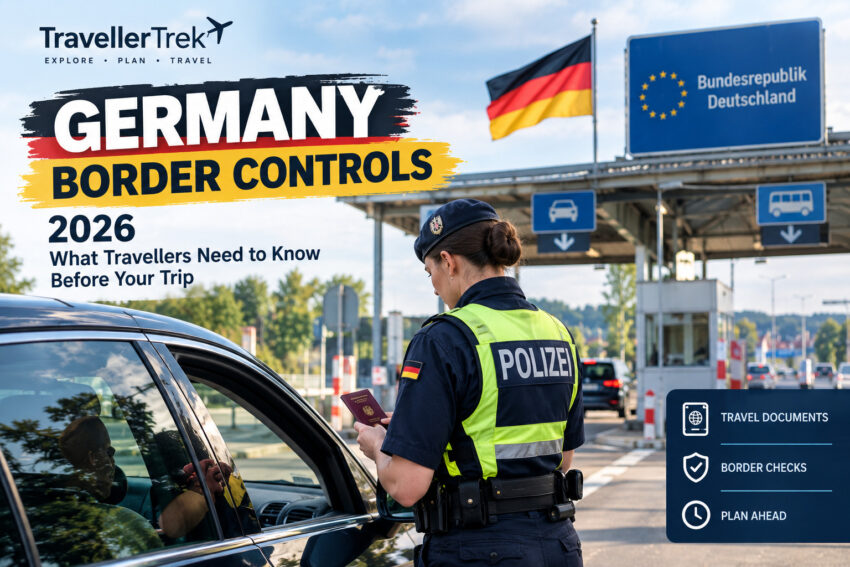

Germany Border Controls 2026: What Travellers Need to Know Before Your Trip
Germany remains part of the Schengen Area, but travellers should not assume that every journey across Germany’s borders will be completely free of checks.
As of September 2026, Germany has temporary internal border controls in place at its land borders with France, Luxembourg, Belgium, the Netherlands, Denmark, Austria, Switzerland, the Czech Republic and Poland.
The current notification covers the period from 16 September 2026 until 15 March 2027. The European Commission lists the controls as relating to continued security and migration-related concerns. (Migration and Home Affairs)
For tourists, international students, workers and people travelling through Germany to another European country, this means carrying the correct travel documents remains particularly important.
🇩🇪 What Are Germany’s Border Controls?
Normally, one of the main advantages of the Schengen Area is the removal of routine checks at internal borders.
However, Schengen countries can temporarily reintroduce internal border controls when they consider there is a serious threat to public policy or internal security. The European Commission describes this as an exceptional, temporary measure that must meet specific legal requirements. (Migration and Home Affairs)
Germany is currently using this mechanism at its land borders with nine neighbouring countries.
This does not mean Germany has left Schengen.
It also does not mean every person crossing the border will necessarily be stopped.
Instead, travellers should be prepared for possible checks when entering or leaving Germany by land.
🗺️ Which German Borders Have Temporary Controls?
According to the European Commission’s current notification, Germany’s temporary controls cover its land borders with:
- 🇫🇷 France
- 🇱🇺 Luxembourg
- 🇧🇪 Belgium
- 🇳🇱 Netherlands
- 🇩🇰 Denmark
- 🇦🇹 Austria
- 🇨🇭 Switzerland
- 🇨🇿 Czech Republic
- 🇵🇱 Poland
The current notified period runs from 16 September 2026 to 15 March 2027. (Migration and Home Affairs)
This is particularly relevant for people travelling by car, bus or train between Germany and neighbouring countries.
✈️ Does This Affect People Flying to Germany?
There are two different issues travellers should understand.
Temporary internal border controls mainly concern Germany’s land borders with neighbouring Schengen countries.
Separately, travellers arriving in Germany from outside the Schengen Area are subject to the normal external Schengen border checks.
Germany’s Federal Police also confirms that the new Entry/Exit System (EES) has been fully operational at German airports and seaports since 10 April 2026. (bundespolizei.de)
For eligible non-EU short-stay travellers, EES records information such as travel-document details, fingerprints and a facial image. (Migration and Home Affairs)
So, someone flying directly from Pakistan to Germany is dealing primarily with external Schengen border procedures, while someone travelling from France or Poland into Germany may encounter the temporary internal border controls.
🛂 What Documents Should Travellers Carry?
If you’re travelling through Germany, keep your required documents easily accessible.
Depending on your circumstances, this can include:
- Valid passport
- Valid Schengen visa, if required
- Valid residence permit, if applicable
- Long-stay visa, where applicable
- Travel documents required for your specific status
Germany’s Federal Police states that even between Schengen countries, travellers are still required to carry a valid identity document or passport. (bundespolizei.de)
This is especially important when temporary border controls are operating.
🚆 What About Trains and Buses?
Travellers crossing Germany’s land borders by train or bus should be prepared for possible checks.
A border crossing does not automatically mean that every passenger will be stopped, but temporary controls can result in police checks during journeys.
Germany’s Federal Police also notes that controls can take place within the border area, including up to 30 kilometres from the border in certain circumstances. During such checks, people may be required to show identification and other documents they are required to carry. (bundespolizei.de)
Example
Imagine you’re travelling:
Paris → Frankfurt → Berlin
You are travelling between Schengen countries, but Germany’s temporary controls at the French border mean you should still be prepared to show your travel documents.
The same principle applies to journeys from countries such as Poland, Austria, Switzerland or the Czech Republic.
Does This Mean Schengen Is Ending?
No.
Germany remains part of the Schengen Area.
Schengen generally allows people to cross internal borders without routine passport controls. However, countries can temporarily reintroduce controls under the Schengen rules in exceptional circumstances. (Migration and Home Affairs)
Therefore:
Schengen = normally no routine internal border checks
but
Schengen ≠ a guarantee that border checks can never happen.
This distinction is important for anyone planning a multi-country European trip.
🧳 What Should Tourists Do?
If Germany is part of your European itinerary, a few simple precautions can make your journey easier.
1. Keep your passport accessible
Don’t put your passport deep inside your luggage when travelling between European countries.
2. Carry your residence permit if you have one
If you live in an EU or Schengen country, keep your valid residence documentation with you.
3. Check your visa conditions
A Schengen visa does not automatically mean that every travel situation is permitted. Check the validity, duration and conditions of your visa.
4. Allow extra time
If you’re travelling by train, bus or car across a German border, allow some additional time in your itinerary in case checks cause delays.
5. Check official information before travelling
Border-control arrangements can change. Check the latest information before starting your journey.
What Does This Mean for Pakistani Travellers?
For Pakistani travellers visiting Germany, the most important point is simple:
A valid Schengen visa remains important, but travellers should also be prepared for border checks during their journey.
For example, if you fly from Pakistan to Germany and then travel by train to France, Austria or another neighbouring country, you should continue carrying your passport and any relevant residence or visa documents.
If Germany is only one stop on a larger European trip, don’t assume that crossing an internal Schengen border will always happen without any checks.
⚠️ Important: Border Controls Don’t Mean You Need a New Visa
Temporary German internal border controls do not create a new German visa requirement for every traveller.
If you already have a valid visa allowing your intended travel, the existence of temporary internal controls does not by itself mean you need to obtain a separate German border visa.
The purpose is to allow checks at the relevant internal borders.
Always verify your individual visa and entry conditions before travelling.
📌 Germany Border Controls at a Glance
| Question | Current situation |
|---|---|
| Is Germany still in Schengen? | ✅ Yes |
| Are temporary internal border controls in place? | ✅ Yes |
| Current notified period | 16 Sept 2026 – 15 Mar 2027 |
| Land borders affected | 9 neighbouring countries |
| Does everyone get stopped? | ❌ Not necessarily |
| Should travellers carry documents? | ✅ Yes |
| Does this mean Schengen has ended? | ❌ No |
| Can arrangements change? | ✅ Yes |
Final Takeaway
Germany’s temporary border controls are an important reminder that Schengen does not always mean completely border-free travel.
As of September 2026, Germany has notified temporary controls at its land borders with nine neighbouring countries, currently covering 16 September 2026 through 15 March 2027. (Migration and Home Affairs)
For travellers, the practical message is straightforward:
Keep your passport and required travel documents with you, allow extra time for land-border journeys, and check the latest official information before travelling.
Whether you’re visiting Germany for tourism, studying there, working there or travelling onward to another European country, being prepared for a possible document check can help avoid unnecessary problems.
Official Sources
- European Commission — Temporary Reintroduction of Border Control
- German Federal Police — Controls in the Border Area
- German Federal Police — Schengen Travel Information
- German Federal Police — EES in Germany