
EU Migration Rules 2027: European Commission Announces New Solidarity Plan for Member States
Introduction
The European Union is taking another important step towards coordinating migration management across its member states.
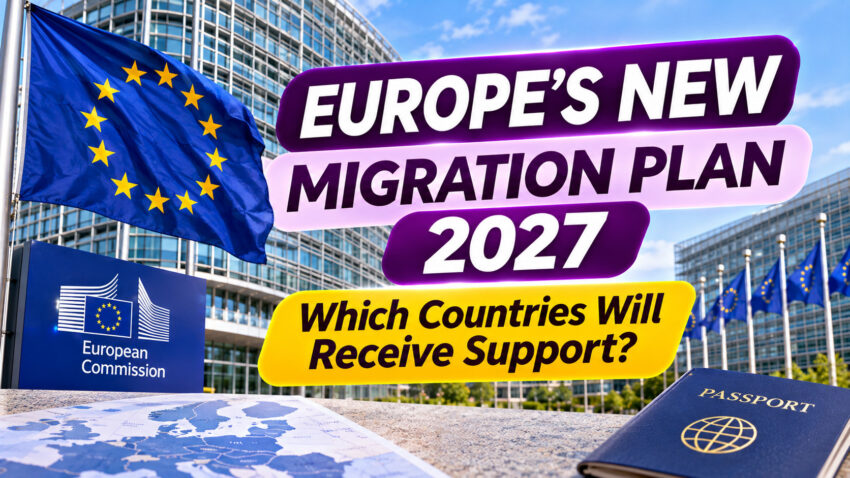
On 5 November 2026, the European Commission announced the second Annual Migration Management Cycle, presenting its latest assessment of migration trends, identifying countries experiencing migration pressure and proposing a new Solidarity Pool for 2027.
The announcement is part of the EU’s wider Pact on Migration and Asylum, which entered into application in June 2026.
The new plan is designed to help countries facing disproportionate migration pressure while sharing responsibilities across the European Union.
But what exactly is the Solidarity Pool? Which countries have been identified as facing pressure? And does this announcement change the immigration rules for people hoping to move to Europe?
Here is what you need to know.
1. What did the European Commission announce?
The European Commission launched its second Annual Migration Management Cycle in November 2026.
This annual process reviews migration trends and risks across EU member states.
It also identifies countries that are experiencing significant pressure on their migration and asylum systems.
Following its assessment, the Commission proposed a second Solidarity Pool for 2027.
The purpose is to provide support to countries facing disproportionate migration challenges.
The announcement includes three important elements:
- A new assessment of migration trends across the EU.
- Identification of member states facing migration pressure or significant migration situations.
- A proposal for solidarity contributions between EU countries in 2027.
The proposal still requires a decision by the Council before the final contributions become legally binding.
2. Which European countries are facing migration pressure?
The Commission identified four countries as being under migratory pressure.
These are:
- Greece
- Spain
- Cyprus
- Italy
According to the Commission, these countries experienced disproportionate levels of arrivals over the previous year.
Italy’s situation was also linked to arrivals following search-and-rescue operations at sea.
These countries will be eligible to access the Solidarity Pool, subject to the applicable responsibility rules.
This does not mean that these countries are closing their borders or introducing new visa restrictions for ordinary visitors.
The classification concerns migration-management pressure, particularly the capacity to manage asylum arrivals and related responsibilities.
3. Which countries are at risk of migration pressure?
The Commission also identified 15 countries as being at risk of migratory pressure.
These include:
- Belgium
- Czechia
- Germany
- Estonia
- Ireland
- France
- Croatia
- Latvia
- Lithuania
- Luxembourg
- Netherlands
- Poland
- Romania
- Slovenia
- Finland
These countries will have priority access to the Permanent EU Migration Support Toolbox.
Their situations will also be monitored and reassessed where necessary.
The assessment considers several factors, including asylum applications, irregular arrivals, secondary movements and the number of people receiving temporary protection.
For example, Germany and France are among the countries identified as being at risk of future pressure.
However, this classification does not automatically mean that either country is introducing new immigration restrictions.
4. What is the EU Solidarity Pool?
The Solidarity Pool is a mechanism under the EU’s Pact on Migration and Asylum.
Its purpose is to support member states facing disproportionate migration pressure.
Instead of leaving countries with particularly high arrival numbers to manage the situation alone, other EU countries can contribute through different forms of support.
For 2027, the European Commission has proposed establishing the second Solidarity Pool.
The final size and contribution arrangements still need to be agreed by the Council.
Once adopted, the member states’ contributions will become legally binding.
5. How can EU countries contribute?
The Commission has outlined several ways member states can contribute to the proposed 2027 Solidarity Pool.
These include:
1. Relocation of asylum applicants
Countries can accept the transfer of asylum applicants from member states facing significant pressure.
This helps distribute responsibility among participating countries.
2. Financial contributions
Member states can provide financial support to help countries manage migration-related responsibilities.
3. Responsibility offsets
The framework allows contributions through responsibility offsets under the relevant EU rules.
4. Alternative measures
Countries can also contribute through other approved measures.
5. A combination of contributions
Member states may combine different forms of support depending on the arrangements agreed by the Council.
The final contribution system will be confirmed after the Council adopts its decision.
6. What is the EU Pact on Migration and Asylum?
The Pact on Migration and Asylum is a major reform of the European Union’s migration and asylum system.
It consists of a package of 10 legislative acts designed to establish more consistent procedures across member states.
The Pact entered into application on 12 June 2026.
Its main objectives include:
- More consistent screening of irregular arrivals.
- Improved identification and registration procedures.
- Common rules for asylum applications.
- Faster procedures in certain border cases.
- Clearer responsibility arrangements between member states.
- A solidarity mechanism for countries facing migration pressure.
The reforms are intended to balance responsibility and cooperation across the EU.
The new Solidarity Pool for 2027 is part of this wider framework.
7. What does the new migration report say about European arrivals?
The European Commission’s latest report also included information about migration trends.
According to the Commission:
- Illegal border crossings fell by more than one third in the first half of 2026.
- They had already fallen by more than 50% over the previous two years.
- Secondary movements and asylum applications decreased significantly.
- Returns continued to increase.
The report also highlighted progress in implementing the Pact.
The new Eurodac system is operational across all member states, while most countries are carrying out screening procedures for irregular arrivals and have operationalised border procedures.
However, the Commission also acknowledged that further work is needed.
In particular, some gaps remain around responsibility rules and the transfer of asylum applicants between member states.
8. Does this announcement affect Pakistani travellers and visa applicants?
This is an important question for people following European immigration news from Pakistan.
The November announcement does not introduce a new visa category for Pakistani citizens.
It also does not automatically make it easier or harder for Pakistani nationals to obtain:
- Schengen tourist visas.
- European student visas.
- Work permits.
- Residence permits.
- Family reunification visas.
The Solidarity Pool primarily concerns cooperation between EU member states in managing asylum and migration responsibilities.
Pakistani nationals must continue following the individual immigration and visa requirements of their intended destination.
For example, someone planning to study in Germany must still meet the German student residence requirements, while someone applying for a work permit in Italy must follow the relevant Italian immigration procedures.
9. What happens next in 2027?
The European Commission has proposed the second Solidarity Pool, but the final arrangements are not yet complete.
The Council must agree on:
- The overall size of the Solidarity Pool.
- The contributions expected from member states.
- How different forms of solidarity will be organised.
Once the Council adopts its decision, member states’ contributions will become public and legally binding.
The Commission will continue monitoring migration trends and the implementation of the Pact.
This means further developments can be expected as the 2027 arrangements are finalised.
10. Why is this important for Europe’s future immigration policy?
Migration remains one of the major policy issues facing the European Union.
Countries on the EU’s external borders often face different challenges from countries receiving people through secondary movements or asylum transfers.
The new framework is intended to create a more coordinated response.
For travellers, students and workers, the most important distinction is that migration-management policy is not the same as ordinary visa policy.
The Solidarity Pool is about how EU governments share responsibilities for asylum and migration pressures. It does not directly change the eligibility requirements for tourism, education or employment visas.
Nevertheless, developments in the EU’s migration framework are important because they influence how European countries coordinate their border and asylum systems.
Final Thoughts
The European Commission’s announcement of 5 November 2026 is an important development in Europe’s migration policy.
Greece, Spain, Cyprus and Italy have been identified as countries under migration pressure, while 15 other member states have been classified as being at risk.
The proposed 2027 Solidarity Pool is designed to help distribute migration-management responsibilities through relocation, financial support and other approved contributions.
However, the final arrangements still require approval by the Council.
For international travellers and people planning to move to Europe, the key point is that this announcement does not create a new visa route or automatically change existing work, study or tourist visa requirements.
What do you think? Should European countries share migration responsibilities more equally? Share your opinion in the comments.
Official Sources
- European Commission — Commission launches second Annual Migration Management Cycle, 5 November 2026
- European Commission — Pact on Migration and Asylum
- European Commission — Asylum and Migration Management Regulation
- Council of the European Union — Migration and asylum policy
Disclaimer: This article is for general information and immigration awareness. The 2027 Solidarity Pool is a proposal pending a Council decision. Migration and asylum arrangements may develop as the EU implements its new framework.