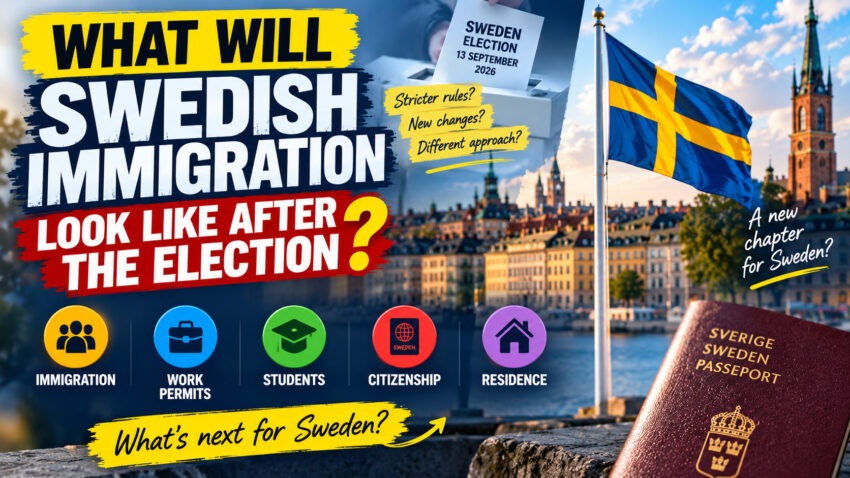

Swedish Immigration After the 2026 Election: What Could Change?
Sweden’s 13 September 2026 general election could influence the country’s immigration direction for the next four years. But there is an important point to understand: many of the major immigration changes people are discussing have already entered into force in 2026. The election is therefore more about what Sweden does next than about immediately reversing everything that has already changed. (Valcentralen)
Why This Election Matters for Immigration
Immigration, integration, citizenship and security have become major political issues in Sweden.
The current governing camp has pursued a more restrictive migration policy, while opposition parties are proposing changes in areas such as labour migration, residence permits and integration. The final outcome depends on the election result and subsequent negotiations over who can form a government. Sweden’s Riksdag elects the prime minister after the election. (Riksdagen)
So, what could change for foreigners living in Sweden or planning to move there?
🛂 1. Asylum & Protection Could Remain Strict
Under the current government’s approach, Sweden has sought to reduce asylum-related immigration and align its asylum legislation with EU minimum standards.
The Moderate Party says it wants to further reduce asylum-related immigration and pursue a restrictive approach. (Moderaterna)
The Social Democrats, meanwhile, say Sweden should protect the right to asylum while keeping migration policy within EU minimum standards. They also support measures aimed at improving integration and increasing returns for people whose asylum applications are rejected. (Social Democrats)
What this means: a change of government would not necessarily mean a return to Sweden’s previous migration model.
2. Swedish Citizenship Has Already Become Much Tougher
This is one of the biggest changes to watch.
Since 6 June 2026, the general residence requirement for Swedish citizenship has increased from five years to eight years. Applicants also face stronger requirements concerning good conduct, self-support, Swedish language and knowledge of Swedish society. (Migrationsverket)
The new maintenance requirement generally requires an applicant to have long-term income of approximately SEK 20,000 per month before tax, with exemptions for certain groups. (Migrationsverket)
Citizenship knowledge tests are also being introduced gradually. The first part, concerning Swedish society, began in August 2026, while the Swedish-language testing element is scheduled for later implementation. (Migrationsverket)
Could this change after the election?
Possibly, but that would require new political decisions and legislation. It should not be assumed that a new government would automatically remove the rules.
Interestingly, the political differences are more nuanced than simply “strict versus liberal.”
The Moderates want to explore a faster citizenship route for highly skilled and well-integrated workers, while still maintaining stronger requirements overall. (Moderaterna)
💼 3. Work Permits Could Become a Major Battleground
Sweden introduced a significant new salary requirement for work permits in June 2026.
For ordinary work permits, the salary must currently be at least 90% of Sweden’s median salary. Based on the current median salary, that means SEK 34,470 per month. The salary must also meet applicable collective-agreement or industry standards. (Migrationsverket)
This has created a major political divide.
The Centre Party wants to abolish the government’s high salary floor and instead use collective-agreement-level wages as the standard. It also wants permanent residence permits to remain permanent. (Centerpartiet)
The current government, on the other hand, has moved toward a more selective labour-migration system.
What could happen?
A new government could adjust the salary threshold, exemptions or labour-migration rules, particularly if it prioritises attracting skilled workers and preventing “competence deportations.”
But people considering Sweden should use the rules currently in force, not assume a future political change will make eligibility easier.
🏡 4. Permanent Residence Is Changing
Sweden has also moved toward a system in which permanent residence permits are generally no longer granted, although exceptions and transitional arrangements apply.
Since July 2026, certain people with temporary permits can still qualify for citizenship without holding permanent residence when they fall within specified categories and have well-founded prospects of obtaining long-term residence. (Migrationsverket)
This could become one of the most politically important issues after the election.
Some opposition proposals point toward preserving permanent residence for people who work, contribute and have established lives in Sweden. The Centre Party, for example, explicitly says permanent residence permits should remain permanent. (Centerpartiet)
👨👩👧 5. Family Immigration & Integration
The direction of Swedish immigration policy is increasingly connected to integration.
The Social Democrats propose establishment permits with requirements related to Swedish language and social knowledge, alongside policies aimed at helping newcomers become self-supporting. (Social Democrats)
The Centre Party also advocates combining clear requirements with stronger routes into Swedish language learning, education and employment. (Centerpartiet)
This means that even under a different government, integration is likely to remain a central part of Sweden’s immigration debate.
🔮 Three Possible Post-Election Scenarios
Scenario 1 — Current governing camp remains in power
Expect the restrictive direction to continue.
That could mean tighter migration controls, stronger return policies, strict citizenship requirements and selective labour migration.
Scenario 2 — Centre-left government takes power
Some policies could be softened, especially around labour migration, permanent residence and individual cases involving people strongly established in Sweden.
But this would not necessarily mean open immigration. The Social Democrats themselves support controlled migration, integration requirements and effective returns. (Social Democrats)
Scenario 3 — Coalition negotiations produce a mixed approach
Swedish politics could produce compromises rather than a complete policy reversal.
Some rules may stay, while others are amended through negotiations between parties.
What About People Planning to Move to Sweden?
For workers, students and families, the most important lesson is simple:
Don’t wait for a hypothetical policy change.
Sweden’s rules are already changing rapidly. Work-permit salary requirements, citizenship conditions and residence rules currently operate under the 2026 framework. (Migrationsverket)
Anyone planning a move should check the rules that apply at the time they actually submit their application.
🔥 The Bigger Picture
The 2026 election could change the speed, priorities and direction of Swedish immigration policy.
But Sweden’s immigration debate has already shifted significantly toward:
🇸🇪 stronger integration
💼 selective labour migration
🛂 tighter residence rules
🗣️ greater emphasis on Swedish language and society
🏡 more conditional pathways to long-term residence
📋 tougher citizenship requirements
The biggest question after the election may therefore not be:
“Will Sweden become strict or open?”
but rather:
“How much of Sweden’s new restrictive immigration model will the next government keep — and how much will it change?”
For international workers, students and families, that answer could matter enormously.
Sources
Official Swedish Migration Agency guidance on the 2026 citizenship and work-permit changes; Swedish Riksdag information on post-election government formation; and 2026 migration policy positions published by Swedish political parties. (Migrationsverket).