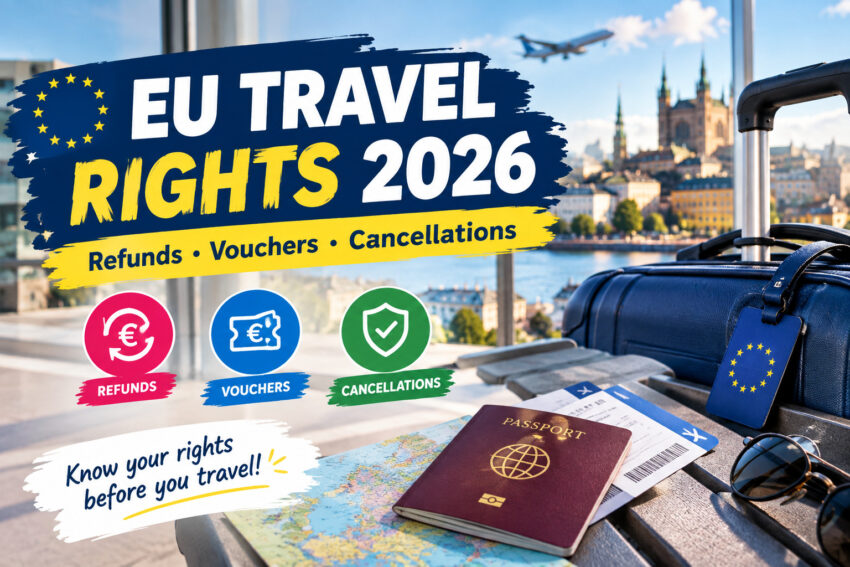

EU Package Holiday Rules 2026: Refunds, Vouchers and Your Travel Rights
Planning a holiday in Europe? If you book a package holiday that combines services such as flights, accommodation, transfers or excursions, new European Union rules are set to strengthen traveller protections.
The revised EU Package Travel Directive entered into force on May 28, 2026. It clarifies cancellation and refund rights, establishes clearer rules for travel vouchers, strengthens protection when a travel organiser becomes insolvent and improves the information travellers must receive before booking.
However, entry into force does not mean every new rule is already binding on travel companies. EU member states have 28 months to incorporate the changes into national law, followed by another six months before the new rules become applicable to operators.
Here is what travellers need to know and how to prepare for their next European holiday.
What is the EU Package Travel Directive?
The Package Travel Directive is an EU consumer-protection law covering qualifying holiday packages sold by travel agencies, tour operators and online booking businesses.
A package holiday can combine two or more travel services, such as:
- Flights and hotel accommodation
- Accommodation and airport transfers
- A hotel stay combined with excursions
- Several travel services purchased together through one booking process
Not every combination of bookings qualifies as a package. Booking a flight and then independently reserving a hotel through a separate provider may receive different legal treatment, depending on how the bookings are arranged.
Before paying, check whether the company is selling you a protected package or separate travel services.
1. New rules clarify cancellation and refunds
One of the main purposes of the revised directive is to make travellers’ rights clearer when a package holiday is cancelled or cannot be provided.
Under the revised framework, travellers have a right to cancel a package without termination fees when unavoidable and extraordinary circumstances significantly affect the package or its performance, subject to the applicable legal conditions.
Examples could include serious events that make travel to the destination unsafe or significantly disrupt the holiday.
The circumstances of each case matter. A change of personal plans, for example, does not automatically qualify as an extraordinary circumstance that allows a fee-free cancellation.
The revised directive also clarifies the refund obligations of package organisers. When an organiser cancels a package, the revised framework provides for reimbursement within 14 days.
Traveller tip: Before cancelling, ask the organiser to explain the applicable cancellation terms and whether the circumstances of your trip qualify for a refund without cancellation fees.
2. Can a travel company force you to accept a voucher?
The revised rules clarify the conditions under which travel vouchers can be offered instead of cash refunds.
Under the revised framework, vouchers must meet conditions including:
- They must be worth at least as much as the refund they replace.
- They can be valid for no more than 12 months.
- They can be transferred once.
- They must receive the required insolvency protection.
Travellers must expressly consent to accepting a voucher instead of a refund. The revised framework also provides for an automatic refund when a voucher is not redeemed.
This is important for people whose holidays are cancelled during major disruptions. A voucher may be convenient if you intend to travel later, but a refund may be more suitable if your plans have changed.
Remember: Check the national rules applicable to your booking and whether the revised provisions have become applicable in the country concerned.
3. What happens if your tour operator goes bankrupt?
A travel organiser’s financial failure can leave customers uncertain about recovering their money or completing their journey.
The revised directive strengthens insolvency protection for package travellers.
Under the revised framework, travellers should receive reimbursement within six months if the package organiser becomes insolvent. In duly justified circumstances, this period may be extended to nine months.
The directive also strengthens the information travellers receive about insolvency protection.
Before booking, check:
- Who is legally responsible for organising your package.
- Whether your booking includes insolvency protection.
- Which organisation handles refund claims if the company fails.
- Whether you may be entitled to assistance or repatriation if you are already travelling.
These checks are particularly useful when booking an expensive holiday or travelling with several family members.
4. Better information before you book
The revised directive also aims to make package-holiday information clearer.
Travellers should receive relevant information about matters such as:
- The services included in the holiday
- Payment methods and additional charges
- Passport and visa requirements
- Accessibility arrangements
- Cancellation conditions and fees
- Whether the booking is a package or separate travel services
This information can help you compare offers and understand what you are paying for.
For travellers visiting Europe from outside the EU, remember that package-holiday protection does not replace immigration requirements. You must still meet the entry, visa and residence conditions applicable to your nationality and destination.
5. How long do travel companies have to implement the changes?
The revised directive entered into force on May 28, 2026, but implementation takes place in stages.
EU member states have 28 months to incorporate the new provisions into national legislation. The new requirements then become applicable to operators after a further six months.
This means travellers should not assume that every revised provision is already enforceable against every travel company.
Existing national rules may continue to govern a booking while implementation is underway. The applicable protection can depend on the country, the type of booking and the relevant date.
If you have a dispute, check the current national rules rather than relying solely on a summary of the EU directive.
6. What should you do if your holiday is cancelled?
If a travel organiser cancels your package or becomes insolvent, keep your documents and communicate with the company in writing.
Follow these steps:
Step 1: Keep your booking documents. Save your confirmation, invoice, terms and conditions, receipts and any cancellation notices.
Step 2: Contact the organiser. Ask for a written explanation of the cancellation and the refund options available under the rules applicable to your booking.
Step 3: Check before accepting a voucher. Review its value, validity, transfer conditions and protections before agreeing to it.
Step 4: Check insolvency protection. If the organiser has ceased trading, identify the relevant protection scheme and the procedure for submitting a claim.
Step 5: Seek official assistance if necessary. Contact your country’s consumer-protection authority or European Consumer Centre, where applicable, if the dispute remains unresolved.
If you booked flights and accommodation separately, check each provider’s terms and the laws applicable to those individual bookings. You may not have the same rights as someone who purchased a qualifying package.
7. Do these rules apply to every traveller in Europe?
No. The directive concerns qualifying package travel and the obligations of package organisers. It does not automatically give identical refund rights for every hotel reservation, flight ticket or independently booked holiday.
Its practical effect also depends on national implementation and the circumstances of the booking.
Travellers from outside the EU should pay particular attention to the law applicable to their package and the organiser responsible for it. Do not assume that every booking made by a European website necessarily qualifies for the same protection.
Quick summary: EU package holiday rules in 2026
| Topic | What the revised framework provides |
|---|---|
| Cancellation | Clearer rights when extraordinary circumstances affect a package |
| Refunds | A 14-day reimbursement period when an organiser cancels a package |
| Vouchers | Conditions on value, validity, transfer and protection; traveller consent is required |
| Insolvency | Stronger protection, including reimbursement within six months in the ordinary framework |
| Booking information | Clearer information about services, fees, cancellation and travel requirements |
| Implementation | National transposition followed by a further period before the new rules apply to operators |
Final thoughts
The revised EU Package Travel Directive is intended to make package-holiday protections clearer and strengthen safeguards when trips are cancelled or travel companies fail.
For travellers, the practical lesson is simple: understand what you have booked, keep your documents, check cancellation conditions and confirm which national rules apply before relying on a particular refund right.
The revised directive entered into force in May 2026, but its new provisions are not all immediately applicable to travel operators. Checking the current guidance for the country where your booking falls under the rules is therefore essential.
Official sources
- European Commission: Package travel — stronger rights for travellers and simpler rules for the travel industry
https://commission.europa.eu/news-and-media/news/package-travel-stronger-rights-travellers-and-simpler-rules-travel-industry-2026-05-28_en - Council of the European Union: Package travel
https://www.consilium.europa.eu/en/policies/package-travel/ - European Commission: Package Travel Directive
https://commission.europa.eu/law/law-topic/consumer-protection-law/travel-and-timeshare-law/package-travel-directive_en