
EU Proposes Easier Recognition of Qualifications for Non-EU Citizens
Published: 21 September 2026
Category: Europe Immigration & Jobs
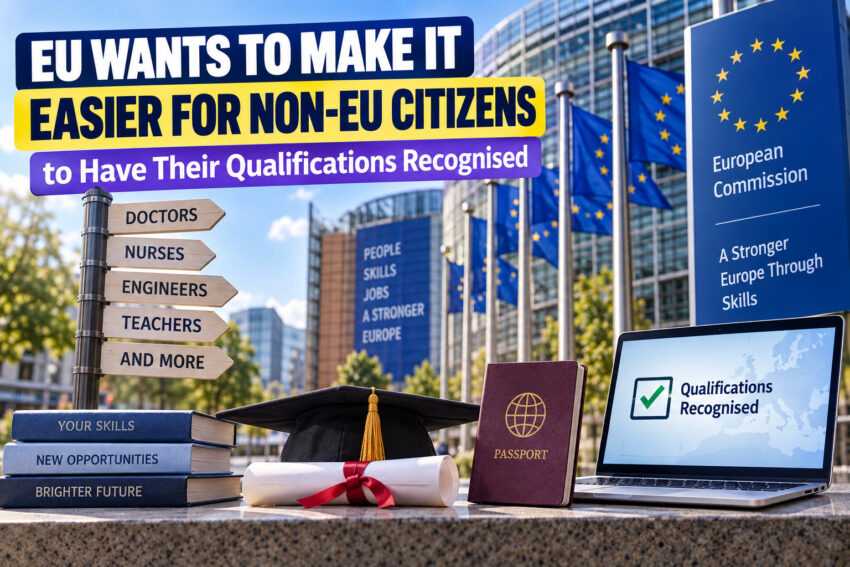
A new European Commission proposal could make it easier for non-EU professionals to have qualifications obtained outside Europe recognised when they want to work in the European Union.
The proposal is part of the EU’s Fair Labour Mobility Package, adopted by the European Commission on 15 September 2026. It includes a specific proposed directive covering the recognition of qualifications of third-country nationals. (Employment, Social Affairs and Inclusion)
For international professionals hoping to build a career in Europe, the proposed changes could make the qualification-recognition process more predictable and less dependent on complicated national procedures.
🎓 What Is the EU Proposing?
At present, people from outside the EU who want to work in a regulated profession generally have to apply for recognition in the EU country where they want to work and follow that country’s procedures.
The European Commission says current procedures for qualifications obtained outside the EU can take around 14 months on average in the situations covered by its proposal. (Employment, Social Affairs and Inclusion)
The proposed rules would establish common standards for recognising qualifications obtained outside the EU.
The Commission’s objective is to bring the recognition process to within four months under the proposed framework. (Employment, Social Affairs and Inclusion)
🌍 Who Could Benefit?
The proposal is particularly relevant to:
- 👨⚕️ Doctors
- 👩⚕️ Nurses
- 👷 Engineers
- 👩🏫 Teachers
- 🧑🔬 Other regulated professionals
It would cover third-country professionals working in the EU or applying from abroad, as well as EU citizens who hold qualifications obtained outside the EU. (Employment, Social Affairs and Inclusion)
This could be particularly relevant for skilled professionals from countries such as Pakistan, India, Nigeria, Egypt, Türkiye and other non-EU countries who are considering employment in Europe.
However, the proposal does not mean that every foreign qualification would automatically be accepted. Regulated professions can continue to have professional, public-safety and consumer-protection requirements. (Employment, Social Affairs and Inclusion)
⏱️ From Around 14 Months to 4 Months?
One of the biggest proposed changes concerns processing times.
According to the European Commission:
Current average:
⏳ Around 14 months
Proposed common standard:
⚡ Recognition completed within 4 months
The Commission says common standards could also reduce administrative costs for employers. (Employment, Social Affairs and Inclusion)
This would not necessarily mean that every individual application would take exactly four months. The proposed framework would establish common procedures and deadlines rather than guaranteeing an identical outcome for every profession and country.
📱 Qualifications Could Become More Digital
The EU is also proposing a wider Skills Portability Initiative.
Under the proposal, qualifications would increasingly be issued in a standardised digital format and could be stored in the EU Digital Identity Wallet.
The Commission also plans an EU qualifications comparison tool to make qualifications easier for employers and authorities to understand and compare. (Employment, Social Affairs and Inclusion)
This could help address one of the problems international workers face: employers may have difficulty understanding how a qualification from another country compares with qualifications used in their own country.
💻 A More Digital Recognition Process
The proposed system would create a more standardised process for qualification recognition.
The Commission’s skills-portability initiative proposes:
- 📄 Standardised digital qualifications
- 🔎 Easier verification of qualifications
- 🌍 An EU-wide comparison tool
- 💻 Digital recognition procedures
- ⏰ Clearer deadlines
- 🗂️ Less administrative paperwork
The Commission says a single European digital entry point would provide common rules, requirements and deadlines for professional recognition. (Employment, Social Affairs and Inclusion)
🩺 What About Regulated Professions?
Regulated professions are particularly important because workers cannot simply start practising without meeting the requirements established by the relevant authorities.
The Commission is also proposing changes to recognition for regulated professions.
For certain professionals, including doctors, nurses, engineers and teachers, a mandatory digital procedure could make cross-border recognition faster.
The Commission says the proposed procedure could reduce recognition to five weeks instead of three months for the relevant cross-border EU recognition cases. (Employment, Social Affairs and Inclusion)
These changes would still maintain professional and public-safety standards.
🌐 Could Some Non-EU Qualifications Receive Automatic Recognition?
The Commission is also proposing common training frameworks for additional regulated professions.
For seven professions where EU-wide training standards already exist, qualifications issued by accredited institutions outside the EU and reviewed by European quality-assurance bodies could qualify for automatic recognition under the proposed framework. (Employment, Social Affairs and Inclusion)
This is an important distinction: automatic recognition would apply only where the specific conditions established by the EU framework are met.
It would not mean automatic recognition of all foreign degrees or professional qualifications.
Why Is the EU Making This Change?
The proposal comes as European countries face skills shortages and difficulties matching workers with available jobs.
The Commission says the Fair Labour Mobility Package is designed to help qualifications move more easily across borders and make it easier for businesses to recruit workers with needed skills. (Employment, Social Affairs and Inclusion)
The Commission also reports that 74% of SMEs face skills gaps, while only around 2% of EU countries currently offer fully digital qualification recognition without physical paperwork. (Employment, Social Affairs and Inclusion)
The initiative is therefore aimed at both workers and employers.
What Could This Mean for Pakistani Professionals?
For a Pakistani professional who wants to work in Europe, the proposal could eventually provide a clearer and more standardised route for qualification recognition.
For example, someone with a professional qualification obtained in Pakistan could potentially benefit from:
📄 Clearer documentation requirements
💻 More digital procedures
⏱️ Defined processing deadlines
🔎 Easier qualification comparison
🇪🇺 More consistent recognition standards
But qualification recognition is only one part of moving to Europe for work.
Depending on the country and profession, applicants may still need to meet requirements concerning:
- Work permits or residence permits
- Professional registration
- Language skills
- Work experience
- Professional examinations
- Employer requirements
- Sector-specific regulations
The EU proposal does not remove these requirements.
⚠️ Is This Rule Already in Force?
No.
This is an important point for anyone planning to work in Europe.
The European Commission adopted the proposal on 15 September 2026, but the legislative proposals still need to go through the European Parliament and the Council before becoming EU law. (Employment, Social Affairs and Inclusion)
The Commission says the first practical benefits will appear after the proposals are adopted and enter into force.
For non-EU qualifications specifically, simpler recognition is expected within two years of adoption, while digital qualifications and easier recognition for regulated professions are planned within three years. (Employment, Social Affairs and Inclusion)
So applicants should not assume that the four-month standard is already available across the EU today.
🗓️ What Happens Next?
The process is expected to move through several stages:
1️⃣ European Commission proposal
The Commission adopted the Fair Labour Mobility Package in September 2026.
2️⃣ European Parliament and Council
The legislative proposals must be considered and negotiated.
3️⃣ Formal adoption
Once the legislation is adopted, the new framework can begin entering into force.
4️⃣ National implementation
EU countries will then implement the relevant requirements.
5️⃣ Practical changes
The Commission expects simpler recognition of non-EU qualifications within two years of adoption. (Employment, Social Affairs and Inclusion)
❓ Does This Mean Anyone With a Foreign Degree Can Work in Europe?
No.
Qualification recognition and immigration permission are separate issues.
Having a recognised degree or professional qualification does not automatically give someone the right to live or work in an EU country.
A person may still need the appropriate visa, residence permit, work authorisation and professional registration.
The EU’s existing information for third-country nationals makes clear that people seeking regulated professions generally need to follow the relevant country’s recognition procedures. (Employment, Social Affairs and Inclusion)
The Bigger Picture
The qualification proposal is only one part of the EU’s wider Fair Labour Mobility Package.
The package contains five legislative proposals covering:
- 🎓 Skills and qualifications
- 🛂 Recognition of qualifications of third-country nationals
- 💻 Digital qualifications
- 🧾 European Social Security Pass
- 👷 European Labour Authority
The broader objective is to make it easier for skills, workers and social-security rights to move across European borders while maintaining worker protections. (Employment, Social Affairs and Inclusion)
📌 Key Takeaways
🇪🇺 The EU has proposed new rules for recognising qualifications obtained outside the EU.
⏱️ The proposal aims to reduce recognition procedures from an average of around 14 months to four months in the covered cases.
💻 Qualification recognition would become more digital and standardised.
👨⚕️ Doctors, nurses, engineers, teachers and other regulated professionals could benefit from faster procedures under relevant rules.
🌍 The proposal specifically covers third-country professionals and EU citizens with non-EU qualifications.
⚠️ The changes are not yet fully in force. They still need to pass through the EU legislative process.
For international professionals considering Europe, this could become an important development — but the final rules and national implementation will determine exactly how the system works.
Official sources: European Commission — Fair Labour Mobility Package · EU Skills Portability Initiative · European Commission — Social Rights for Workers