
✈️ Europe Is Changing Air Passenger Rights: What Travellers Need to Know in 2026
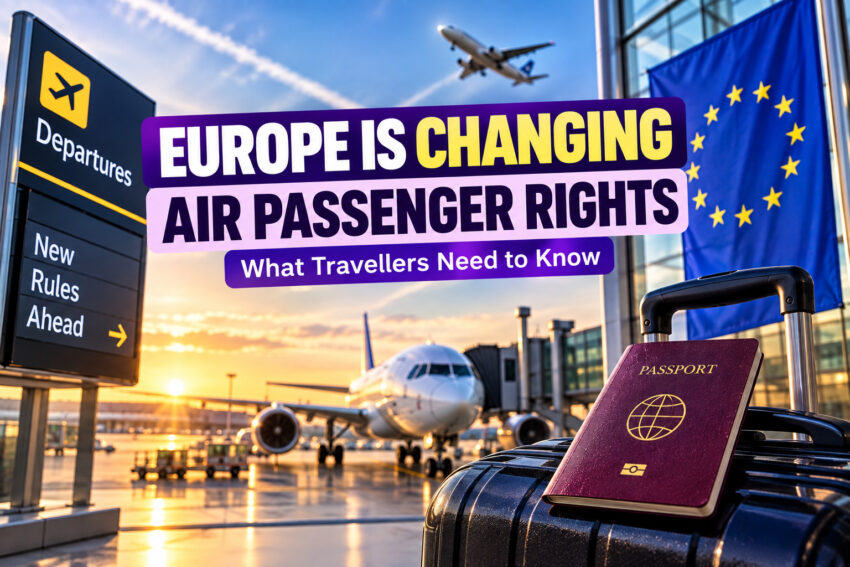
Europe is updating its air passenger protection rules, bringing clearer procedures, stronger protections for some travellers and new requirements for airlines.
The reform follows a political agreement between the European Parliament and the Council in June 2026. Parliament approved the agreed text in July, and the Council gave its final approval on 13 July 2026. (Consilium)
However, the new rules are not immediately applicable. They will enter into force 20 days after publication in the EU Official Journal and then have a transition period before they start applying. (Consilium)
🛫 What Is Changing?
The updated rules are designed to make air passenger rights clearer and easier to use when flights are cancelled, delayed or disrupted.
The main changes cover:
- 💶 Compensation
- 🍽️ Assistance during disruptions
- 🔄 Rerouting
- 📢 Information from airlines
- 🧳 Hand-baggage price transparency
- 👨👩👧 Family seating
- ♿ Passengers with disabilities or reduced mobility
- 🚫 “No-show” policies
- 📝 Compensation claims
The reform is the first major overhaul of the EU’s air passenger-rights framework in more than two decades. (Mobility and Transport)
💶 Compensation for Flight Delays
One of the most important points for travellers is that the agreed framework maintains the existing compensation levels.
Depending on the flight distance, compensation can be:
| Flight distance | Compensation |
|---|---|
| Up to 1,500 km | €250 |
| 1,500–3,500 km | €400 |
| Over 3,500 km | €600 |
The framework retains compensation for qualifying cancellations and long delays, subject to the applicable conditions and extraordinary-circumstances rules. (Consilium)
So, despite headlines about changing passenger rights, the reform does not simply remove the existing €250/€400/€600 compensation structure.
⏰ What Happens If Your Flight Is Delayed?
The updated rules aim to make the process clearer when passengers experience significant delays.
Airlines will have to provide clearer information about passenger rights and how compensation can be claimed.
For qualifying disruptions, airlines will also have to acknowledge compensation claims and provide a response within the framework’s specified deadlines. (Consilium)
The European Commission says airlines will have to proactively inform passengers about their rights and the procedure for requesting compensation within 96 hours after a relevant disruption. (Mobility and Transport)
🔄 Stronger Rerouting Rights
Passengers affected by cancellation or denied boarding will have clearer rerouting options.
Where a passenger chooses rerouting at the earliest opportunity, the agreed rules provide for an alternative route within three hours, where applicable.
Depending on the circumstances, rerouting could involve:
✈️ Another airline
🛫 Another airport
🚆 Another form of transport
🛣️ A different route
If the airline fails to provide the required rerouting, the new framework gives passengers a right to arrange alternative travel themselves in certain circumstances and seek reimbursement. (Consilium)
🍽️ What About Food and Accommodation?
The revised rules clarify passengers’ rights to assistance during disruptions.
The agreed framework includes provisions for:
- 🥤 Refreshments
- 🍽️ Meals
- 📞 Communication
- 🏨 Hotel accommodation when an overnight stay is necessary
- 🚕 Transport between the airport and accommodation
The exact assistance available depends on the circumstances of the disruption and the applicable rules. (Consilium)
🧳 Hand Baggage: More Price Transparency
Another important change concerns how airlines display fares.
Under the new rules, airlines will have to display air fares with an allowance for one piece of hand baggage before the booking process begins, making it easier for passengers to compare prices.
This does not mean every airline must include a particular piece of hand luggage in every fare. Airlines retain freedom over their pricing structures, while the rules aim to make comparisons more transparent. (Mobility and Transport)
👨👩👧 Families Could Sit Together Without Extra Charges
The new framework strengthens protections for families travelling with children.
Passengers accompanying a child under 14 will be entitled to adjacent seating without paying an additional seat-selection charge, subject to the conditions in the regulation.
Similar protections apply to certain passengers with disabilities or reduced mobility and pregnant passengers. (Mobility and Transport)
This could make family travel easier when airlines assign seats automatically.
🚫 No More “No-Show” Penalties for Return Flights
A significant change concerns passengers who miss their outbound flight.
Under the new rules, airlines will no longer be able to deny boarding on a return flight simply because the passenger did not take the outbound flight.
This is commonly known as a “no-show” policy.
The reform specifically prohibits this practice for return flights. (Consilium)
♿ Stronger Protection for Passengers With Reduced Mobility
The new framework also strengthens rights for people with disabilities and passengers with reduced mobility.
Measures include:
♿ Better assistance during disruptions
🦽 Stronger protection for mobility equipment
🔄 Improved rerouting rights
💶 Compensation in certain situations where assistance failures cause passengers to miss flights
The rules also provide additional protections for children, unaccompanied minors and pregnant passengers. (Consilium)
🌧️ What Are “Extraordinary Circumstances”?
Airlines may not always have to pay compensation when a disruption results from circumstances outside their control.
The revised framework provides greater clarity around extraordinary circumstances and includes a list of situations that can fall into this category.
However, an airline cannot simply label every disruption “extraordinary.” The circumstances must meet the relevant legal conditions, and the airline must provide an explanation when relying on this exception. (Consilium)
🌍 Who Is Covered?
EU air passenger rights are not limited to EU citizens.
The rules generally cover passengers:
- Flying within the EU
- Departing from an EU country to a non-EU destination
- Arriving in the EU from outside the EU when the flight is operated by an EU airline
So a traveller from Pakistan, India, the UAE, the US or another non-EU country can potentially be protected when travelling on a flight covered by EU passenger-rights rules. (Consilium)
📅 When Will the New Rules Start?
This is important.
The new framework has been formally approved, but travellers should not assume all of the new provisions are already applicable.
The Council’s July 2026 announcement states that the updated rules will enter into force 12 months and 20 days after publication in the Official Journal of the European Union. (Consilium)
Until the new rules become applicable, travellers should continue using the current EU passenger-rights framework.
⚠️ What Should Travellers Do Now?
If your flight is cancelled or significantly delayed today, don’t wait for the new system.
Keep:
📧 Your booking confirmation
🎫 Boarding pass
📱 Airline messages
🧾 Receipts for reasonable expenses
📸 Evidence of delays or cancellations
If you believe your rights have been violated, contact the airline and follow the applicable EU passenger-rights complaint procedure.
Why This Matters for European Travellers
The changes are intended to make passenger rights clearer, easier to enforce and more consistent.
For travellers, the most noticeable changes could include:
✈️ Clearer compensation procedures
💶 Better information about claims
🧳 More transparent fare comparisons
👨👩👧 Better family seating protections
♿ Stronger assistance for passengers with reduced mobility
🔄 Clearer rerouting rights
🚫 Protection against return-flight no-show policies
The reform also forms part of a broader EU effort to improve enforcement of passenger rights across different forms of transport. (Consilium)
📌 Key Takeaway
Europe is strengthening and clarifying its air passenger-rights system — but the changes won’t all apply immediately.
The reform keeps the familiar €250, €400 and €600 compensation levels for qualifying cases while introducing clearer procedures and additional protections for passengers.
If you’re travelling in Europe, it’s worth knowing your rights before something goes wrong. ✈️
Official sources: Council of the EU — Stronger Air Passenger Rights · European Commission — Revised EU Air Passenger Rights · European Parliament — Air Passenger Rights Agreement