
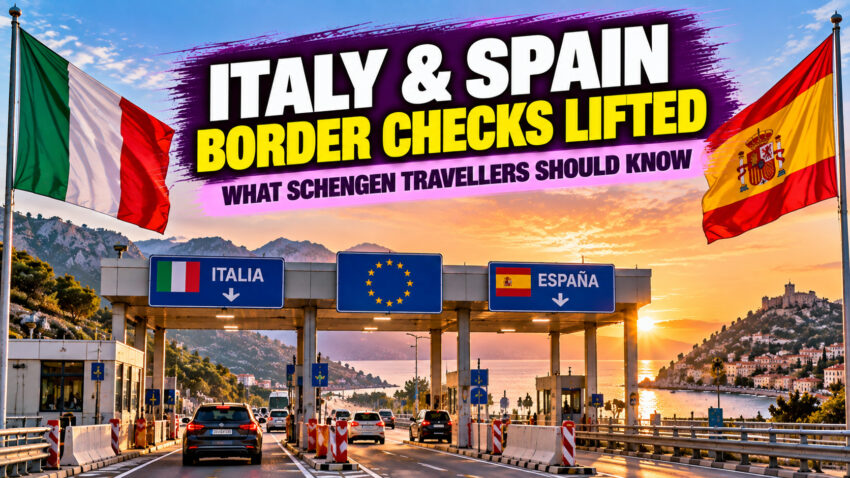

Italy and Spain Lift Border Checks: What Schengen Travelers Need to Know
Traveling between Italy and Spain could become simpler again after the two countries agreed not to extend the temporary border checks introduced during a dispute earlier this year.
On October 22, 2026, Italy and Spain agreed to end the suspension of their usual Schengen arrangements with each other. The decision followed months of tension linked to migration and security concerns surrounding Spain’s North African enclave of Ceuta.
The agreement includes closer information-sharing between the two countries. However, it does not mean that every temporary border check across Europe has ended.
For tourists, international students, workers, and anyone planning a multi-country European trip, understanding the difference is important.
What Happened Between Italy and Spain?
Italy and Spain introduced temporary controls affecting travel between them after a dispute connected to migration developments in Ceuta.
Ceuta is a Spanish autonomous city on the North African coast, bordering Morocco. Events there became a source of concern for Italian authorities, who raised questions about the movement of people onward through the Schengen Area.
Italy suspended its usual open-border arrangements with Spain in late July 2026. Spain subsequently introduced similar restrictions affecting travel from Italy.
The measures disrupted the normal expectation of routine-free movement between the two Schengen countries.
On October 22, the two governments agreed not to extend the suspension further. Their agreement followed discussions between their interior ministers and includes enhanced information-sharing to support security cooperation.
Source: Reuters — Italy and Spain lift border controls brought after Ceuta migrant rush
What Does the Agreement Mean?
The main development is that Italy and Spain have agreed not to continue their mutual suspension of the usual Schengen arrangements.
For travelers, this means the special bilateral controls introduced during the dispute are not being extended under that arrangement.
However, travelers should not interpret this as a guarantee that they will never encounter an identity check or other inspection while crossing between the two countries.
Authorities may still carry out checks under applicable law, and temporary internal border controls can be introduced in the Schengen Area when the relevant conditions are met.
The agreement also does not remove the normal passport, visa, and entry requirements that apply to international visitors.
Why Were the Border Checks Introduced?
The dispute developed after large numbers of people entered Ceuta from Morocco during a period of heightened migration pressure.
Italian authorities expressed concern about onward movement within the Schengen Area and the potential consequences for internal security and migration management.
Spain objected to Italy’s measures and criticized the suspension of the usual open-border arrangements.
The two countries eventually agreed to stop extending the mutual controls and rely on enhanced information-sharing instead.
The episode illustrates how developments at one part of Europe’s external border can influence political discussions about internal Schengen travel.
Does This Mean the Schengen Area Is Fully Open Again?
No. The agreement concerns the Italy–Spain dispute; other Schengen countries still maintain temporary internal border controls.
The European Commission’s notifications list several countries that have reintroduced controls at particular internal borders for specified periods.
These measures differ by country, date, location, and stated reason. They should be checked individually before travel.
For example, the Commission’s published notices include controls involving Germany, France, Austria, Poland, and other countries, with some periods extending into 2027.
The exact scope and dates can change as governments submit new notifications or update existing ones.
Official source: European Commission — Temporary reintroduction of border control
Which Countries Still Have Temporary Border Controls?
The Schengen Area includes many countries that normally allow travel across internal borders without routine passport checks. Temporary controls can nevertheless apply on selected routes.
The European Commission maintains the official list of notifications. Travelers should check it close to their departure date because the situation is time-sensitive.
When reviewing the list, look for:
- The country introducing the control.
- The start and end dates.
- The specific borders or crossing points covered.
- The stated reason and scope of the measure.
A notification affecting one country’s land borders does not necessarily mean that all its airports, train routes, or other borders are subject to the same controls.
Likewise, the existence of a temporary control does not automatically mean that every passenger will be stopped.
What Should Tourists Know Before Traveling?
If you are planning a holiday that includes Italy and Spain, the agreement is a useful update, but normal travel preparation still matters.
1. Carry Valid Travel Documents
Keep your passport and any visa or residence documents required for your journey accessible. Border authorities may request identification even where routine internal checks are not normally conducted.
2. Check Your Route
If you are traveling by air, train, road, or ferry, verify the latest information for your particular route. The rules and practical arrangements can differ depending on how you travel.
3. Allow Extra Time
If your itinerary involves a border where temporary controls remain in place, leave enough time for possible checks, especially when you have a connecting train, flight, or ferry.
4. Check Before Departure
Review the official European Commission border-control notifications shortly before traveling. Do not rely exclusively on an older article or social media post.
5. Keep Your Visa Conditions in Mind
The end of a special border-control arrangement does not extend a visa, increase the permitted duration of a stay, or remove entry requirements.
Travelers must still comply with the conditions attached to their travel permission.
What About Pakistani Travelers?
Pakistani citizens planning short visits to Italy, Spain, or other Schengen countries generally need a valid Schengen visa unless a specific exemption applies.
The Italy–Spain agreement does not introduce a new visa rule for Pakistani citizens, and it does not remove the usual visa requirements.
If you are traveling from Pakistan and planning to visit several European countries, consider the following:
- Obtain the appropriate visa before traveling.
- Check the validity dates and conditions of your visa.
- Make sure your itinerary complies with the applicable Schengen rules.
- Keep accommodation, return-travel, insurance, and other supporting documents available where required.
- Check any transit requirements for countries or airports on your route.
A visa does not automatically guarantee entry. Travelers must still meet the applicable conditions at the external border.
Will Border Checks Affect Train and Road Trips?
They can, depending on the route and whether temporary controls apply.
Travelers crossing between Italy and Spain by air or sea should check the latest carrier information and applicable border guidance. Routes that pass through other countries may be affected by separate controls along the way.
For example, a road trip or train journey involving Germany, France, Austria, or another country with notified temporary controls may have different practical considerations from a direct journey between Italy and Spain.
The key is to check the entire itinerary rather than assuming that one bilateral agreement applies throughout the Schengen Area.
Does This Change the 90-Day Schengen Rule?
No. The agreement between Italy and Spain does not change the standard short-stay limit that generally applies to eligible visitors: up to 90 days in any rolling 180-day period across the Schengen Area.
The calculation covers the Schengen Area as a whole, not 90 days in each country. Specific circumstances and residence permissions can affect how the rules apply.
Travelers should track their entry and exit dates carefully and use official guidance if they are unsure how much time they may spend in the area.
Frequently Asked Questions
Have Italy and Spain ended their temporary border checks?
On October 22, 2026, the countries agreed not to extend the mutual suspension of their usual Schengen arrangements introduced during their dispute. The agreement also includes closer information-sharing.
Are all Schengen border checks ending?
No. Other countries continue to maintain temporary internal border controls at certain borders. Check the European Commission’s current list before traveling.
Do travelers still need passports?
Yes. Carry the travel documents required for your nationality and journey. The absence of routine internal checks does not mean travelers should leave their passports or other required documents behind.
Does the agreement change Schengen visa requirements?
No. It does not remove visa requirements or automatically extend the permitted duration of a visit.
Can Pakistani travelers visit both Italy and Spain on one Schengen visa?
A valid Schengen visa may permit travel across the countries covered by its conditions during its validity period, but travelers must comply with the visa’s terms and applicable entry requirements. Check the visa details and official guidance before departure.
Final Thoughts
Italy and Spain’s decision not to extend their temporary mutual border controls is an important development for European travel. It marks a step away from the exceptional arrangements introduced during their dispute and returns attention to cooperation and information-sharing.
But the broader Schengen situation remains more complex. Other countries continue to use temporary internal border controls, and travel requirements depend on nationality, route, and individual circumstances.
Before your next European trip, check the latest border notifications, carry the correct documents, and confirm the conditions that apply to your visa.