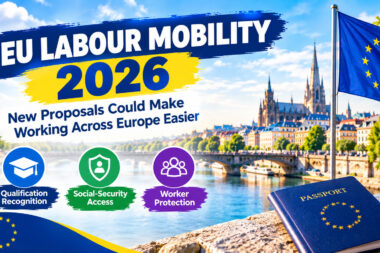

EU Labour Mobility 2026: New Proposals Could Make Working Across Europe Easier
The European Commission has proposed a major new package aimed at making it easier for people to work across EU countries, recognise professional qualifications and manage social-security documents digitally.
For skilled workers, professionals and people already living or working in Europe, the proposals could eventually reduce some of the administrative barriers involved in moving between EU countries.
However, there is an important point to understand: these are proposals, not new rules that workers can use immediately. The European Parliament and the Council still need to adopt the relevant legislation before the main measures can enter into force.
💼 What Is the New EU Labour Mobility Package?
On 15 September 2026, the European Commission adopted its Fair Labour Mobility package.
The package contains five legislative proposals covering areas including:
- Professional qualification recognition
- Digital social-security documents
- Qualifications portability
- Protection of mobile workers
- Stronger enforcement of EU labour rules
- Recognition of qualifications obtained outside the EU
The Commission says the goal is to make it easier for workers to move between EU countries while protecting their social rights and reducing unnecessary administrative procedures.
🌍 Why Does This Matter for People Wanting to Work in Europe?
Moving to another European country for work can involve more than finding a job.
Depending on the profession and country, workers may need to deal with:
🎓 Qualification recognition
📄 Social-security documents
🏥 Health-insurance documentation
🪪 Professional registration
🏢 Employment administration
The Commission says these processes can currently be slow and complicated, particularly for regulated professions and qualifications obtained outside the EU.
The proposed package aims to make several of these processes more digital and easier to verify.
🎓 Professional Qualifications Could Become Easier to Recognise
One of the most significant parts of the proposal concerns professional qualifications.
The Commission proposes a mandatory digital procedure for cross-border recognition of qualifications in regulated professions.
Examples include:
- 👨⚕️ Doctors
- 👩⚕️ Nurses
- 👷 Engineers
- 👩🏫 Teachers
The Commission says the proposed system could reduce recognition procedures for regulated professionals from around three months to five weeks in applicable cases.
This could be particularly relevant to professionals who want to move from one EU country to another but currently face lengthy recognition procedures.
🌎 What About Qualifications From Outside the EU?
This is especially important for people following Europe immigration and work opportunities.
The package includes a proposal for common standards for recognising qualifications obtained outside the EU.
The Commission says procedures that currently take an average of around 14 months could eventually be reduced to around four months under the proposed common standards.
This could affect third-country professionals seeking to work in the EU.
However, it does not mean that a qualification from Pakistan, India, Bangladesh or another non-EU country would automatically become valid everywhere in Europe.
Recognition would still depend on the applicable profession and national requirements.
What Could This Mean for Pakistani Professionals?
For Pakistani professionals considering a European career, this part of the proposal is particularly worth watching.
Imagine a qualified professional applying for work in an EU country.
Today, they may need to provide:
📜 Degree certificates
📄 Professional qualification documents
📝 Translations
🔍 Verification
🏛️ Recognition by the relevant authority
📋 Additional professional documentation
The proposed EU framework is intended to create more common approaches to recognising qualifications obtained outside the EU.
But this is not a new Pakistani-to-EU work visa route.
A person would still need to satisfy the immigration, employment and professional requirements of the country where they intend to work.
🪪 A Digital European Social Security Pass
Another major part of the package is the proposed European Social Security Pass (ESSPASS).
The system would allow people to request and receive certain social-security documents digitally.
The Commission says this could include documents such as:
- European Health Insurance Card
- Portable Document A1
- Other social-security documents
The documents could be stored and presented through the EU Digital Identity Wallet. Authorities would also be able to verify information digitally.
Why could this matter?
People working across borders can currently have to deal with paperwork from multiple authorities.
Digital documents could make it easier to prove social-security coverage when moving or temporarily working in another EU country.
📱 Qualifications Could Also Become Digital
The Commission proposes that qualifications could be issued in a standardised digital format and made available through the EU Digital Identity Wallet.
It also proposes an EU qualifications-comparison tool that would allow workers and employers to better understand qualifications from different European countries.
This could be particularly useful for people applying for jobs in another EU country.
For example, an employer could have an easier way to understand how a foreign qualification compares with qualifications in their own country.
👷 More Protection for Mobile Workers
The package is not only about making migration easier.
It also proposes stronger tools for protecting workers who move between EU countries.
The European Labour Authority would receive stronger powers and tools for:
- Cross-border cooperation
- Labour inspections
- Enforcement of EU rules
- Resolving certain disputes
- Tackling abuse
- Combating illegal employment
The proposal specifically includes a stronger role in addressing abuses involving third-country nationals working in the EU.
⚠️ Is This Already EU Law?
No.
This is one of the most important points for anyone reading about the announcement.
The European Commission has proposed the measures.
The relevant legislation still needs to be adopted by the European Parliament and the Council.
The Commission says people will see the practical benefits only after the initiatives are adopted and the measures enter into force.
So workers should not change their current visa, work-permit or qualification-recognition plans based solely on these proposals.
⏳ When Could the Changes Start?
The implementation would happen in stages if the proposals are adopted.
According to the Commission:
📄 Non-EU qualification recognition
Simpler recognition of non-EU qualifications is expected to be introduced within two years of adoption of the relevant legislation.
📱 Digital qualifications
Digital qualifications and easier recognition for regulated professions are expected within three years of adoption.
🏛️ European Labour Authority
Changes to the European Labour Authority are expected to be implemented progressively, with improvements anticipated during 2028–2030 after the revised mandate is adopted.
These timelines are therefore dependent on the legislative process.
🚨 Does This Mean Europe Is Opening Its Doors to Everyone?
No.
The package is about labour mobility and administrative processes.
It does not create a single EU-wide work visa that automatically allows anyone to work anywhere in Europe.
The Commission specifically states that EU countries retain control over who is admitted to their territory and over professional standards.
So someone from outside the EU would still need to meet the immigration and employment requirements of the particular country.
EU Countries Will Still Have Their Own Immigration Rules
This distinction is important.
The EU can introduce common rules and systems in areas where it has the legal authority to do so, but individual countries continue to operate their own immigration and work-permit systems.
For example, a professional considering:
Germany
France
Netherlands
Sweden
Denmark
Portugal
must still check the specific country’s requirements for admission, employment and professional practice.
The new package is intended to reduce certain administrative barriers — not eliminate national immigration requirements.
📊 How Many Europeans Work Across Borders?
The Commission says around 14 million Europeans live in another EU country, including more than 10 million people of working age.
It also reports that 18% of respondents in a recent Eurobarometer survey said they would like to work abroad.
These figures help explain why the Commission is focusing on making labour mobility more practical.
💡 What Could Change for Job Seekers?
If the proposals become law, workers could eventually benefit from:
🎓 Easier qualification recognition
Less complicated procedures for understanding and recognising professional qualifications.
📱 More digital paperwork
Social-security documents could increasingly be requested, stored and verified online.
🔍 Easier qualification comparison
Employers and workers could have better tools for comparing qualifications across countries.
🛡️ Stronger worker protection
Cross-border enforcement and cooperation could be strengthened.
🌍 Easier professional mobility
People already qualified in one country could potentially face fewer administrative barriers when seeking work elsewhere in Europe.
❌ What Is NOT Changing Yet?
The announcement does not currently mean:
❌ A new EU work visa
❌ Automatic recognition of every foreign degree
❌ Automatic work rights for non-EU nationals
❌ Removal of national work permits
❌ Guaranteed employment in another EU country
❌ Immediate changes to existing immigration rules
These distinctions are important because the package is still going through the EU legislative process.
📌 EU Labour Mobility Package — Quick Guide
| Question | Current position |
|---|---|
| Announced | 15 September 2026 |
| What is it? | Fair Labour Mobility package |
| Is it already law? | ❌ No |
| Qualification recognition | Proposed simplification |
| Non-EU qualifications | Proposed common standards |
| Digital social-security documents | Proposed |
| EU Digital Identity Wallet | Planned integration |
| Work permits abolished? | ❌ No |
| National immigration rules removed? | ❌ No |
| Third-country professionals included? | ✅ Proposed measures |
| Implementation | Gradual, if adopted |
What Should Future European Job Seekers Do Now?
Until the proposals become law, people should continue following the current rules of the country where they want to work.
If you’re planning a move to Europe, focus on:
1. Check whether your profession is regulated.
2. Check whether your qualification needs recognition.
3. Check the country’s current work-permit requirements.
4. Prepare verified educational and professional documents.
5. Check language requirements where applicable.
6. Follow official immigration authorities for changes.
Don’t delay an existing application simply because of the proposed EU package.
🔎 TravellerTrek Takeaway
The European Commission’s new Fair Labour Mobility package could eventually make it easier for workers to move between EU countries by simplifying qualification recognition, digitising social-security documentation and strengthening cross-border worker protection.
For professionals with qualifications from outside the EU, the proposed common standards could be particularly significant because the Commission says recognition procedures could eventually become substantially faster.
But for now, nothing has changed immediately.
The proposals still need to go through the EU legislative process, and national immigration and professional requirements will continue to matter.
For anyone planning a career in Europe, however, this is an EU development worth watching.
Official Sources
European Commission — Fair Labour Mobility Package
European Commission — Guaranteeing social rights for workers everywhere in the EU