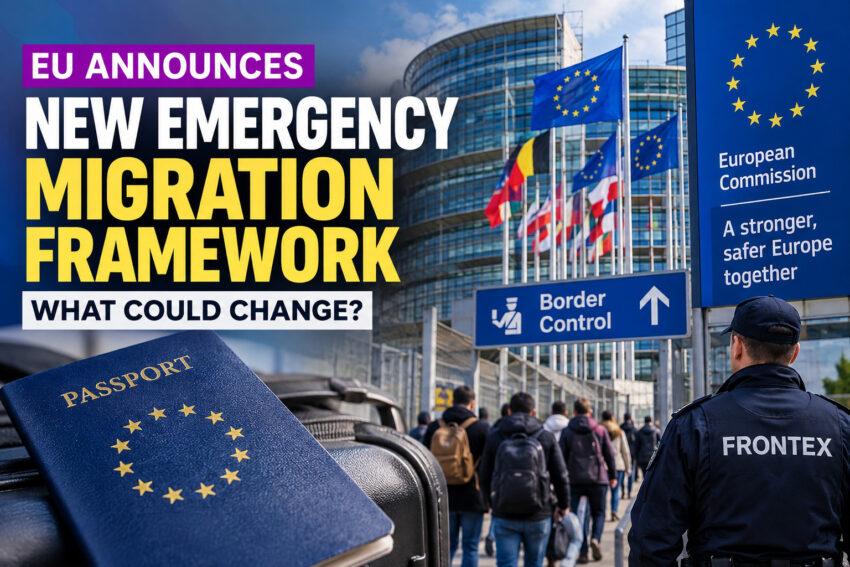

🚨 EU Announces New Emergency Migration Framework: What Could Change?
The European Commission is preparing a new European Emergency Response Framework to help the EU respond to sudden, large-scale migration inflows.
European Commission President Ursula von der Leyen announced the initiative on 16 September 2026 during her State of the Union address to the European Parliament in Strasbourg. The proposal comes after significant migration pressure at several European borders this summer, including the situation in Ceuta, Spain. (Migration and Home Affairs)
🛂 What Is the New Emergency Framework?
The proposed framework would give the EU additional tools for situations involving sudden and exceptional migration movements.
According to von der Leyen, it would only be activated when a strictly defined set of criteria is met. In those circumstances, countries could receive time-limited and clearly defined flexibility in standard procedures. (European External Action Service)
Importantly, this is currently a proposal announced by the European Commission, not a new rule that travellers or migrants must immediately follow.
Why Is the EU Proposing It Now?
The announcement follows migration pressure during the summer of 2026.
One major episode occurred around Ceuta, Spain’s North African territory, where a large number of migrants crossed the border in late July. The European Parliament’s research service said the incident prompted calls for stronger European coordination, including border support, early-warning systems and cooperation with third countries. (EPRS Website)
The Commission says recent events have shown that existing EU tools need to be able to respond more quickly during exceptional situations. (Migration and Home Affairs)
⚖️ What About Asylum Rights?
The proposal does not mean that EU asylum rules have simply been cancelled.
Von der Leyen said the emergency framework would operate under strictly defined conditions and that European measures would continue to respect fundamental rights and EU values. (European External Action Service)
The exact legal mechanism has not yet been published, so it is too early to say precisely how asylum applications or border procedures would operate during a future emergency.
🚨 Could Countries Temporarily Change Normal Procedures?
Potentially, but only under the proposed framework’s conditions.
The Commission describes the mechanism as allowing temporary flexibility in standard procedures during exceptional circumstances. The details — including exactly which procedures could be changed, for how long, and which countries could activate the mechanism — have not yet been fully set out. (Reuters)
This means headlines suggesting that Europe has already introduced a blanket suspension of asylum or migration procedures would be premature.
What Else Is the EU Planning?
The emergency framework is part of a wider migration strategy.
The Commission has also highlighted:
- 🛂 Stronger protection of EU external borders
- 🛰️ Improved early-warning systems
- 🤝 Greater cooperation with non-EU countries
- 🚨 Stronger action against migrant-smuggling networks
- 🔄 Faster returns for people who have no legal right to remain
- 🇪🇺 Greater support for Frontex, the European Border and Coast Guard Agency
These measures were also highlighted in the Commission’s State of the Union migration proposals. (European External Action Service)
📊 What Do the Latest EU Numbers Show?
The latest Eurostat figures published on 16 September 2026 provide some important context.
In June 2026, EU countries recorded 37,075 first-time applications for international protection, 29% fewer than in June 2025. Italy, France, Germany and Greece together received 73% of first-time applications that month. (European Commission)
This shows that migration pressures vary considerably by country and over time, rather than moving in a single direction across the entire EU.
🌍 What Does This Mean for Travellers and Migrants?
For ordinary tourists and short-term visitors, the announcement does not introduce a new visa requirement or automatically change Schengen travel rules.
For migrants and asylum seekers, the potential impact could be more significant if the framework is eventually adopted and activated during a qualifying emergency.
However, the final effect will depend on the legislation the Commission eventually proposes and how EU institutions and member states approve and implement it.
What’s Next?
The European Commission is expected to develop the proposal further before presenting the necessary legislative details.
Until then:
❌ No blanket new EU migration rule has taken effect.
❌ There is no new EU-wide visa requirement announced through this framework.
✅ The Commission has announced plans for a new emergency mechanism.
✅ The mechanism is intended for exceptional, clearly defined situations.
🔎 The Bottom Line
Europe is preparing another major change to its migration-management system.
The proposed European Emergency Response Framework would give the EU additional, temporary tools to respond to sudden large-scale migration situations, while the Commission says fundamental rights would remain protected. (Migration and Home Affairs)
For now, however, the proposal is still being developed. The details of the eventual legislation will determine what it means for asylum seekers, EU countries and Europe’s border system.
🔍 Source:
- European Commission — Migration & Home Affairs: State of the Union 2026 — announcement of the proposed European Emergency Response Framework and related migration measures.
- European Commission — 2026 State of the Union Speech — full text of President von der Leyen’s speech, including the proposed emergency framework.