
Portugal Storm Charles 2026: Flights Cancelled, Airports Disrupted and Nationwide Alert Declared
Introduction
Travelling to Portugal on 11 November 2026? Check your flight and travel arrangements before leaving for the airport.
Portugal has declared a nationwide state of alert following severe weather associated with Storm Charles. The storm has brought heavy rain, strong winds and dangerous coastal conditions, creating significant disruption across the country.
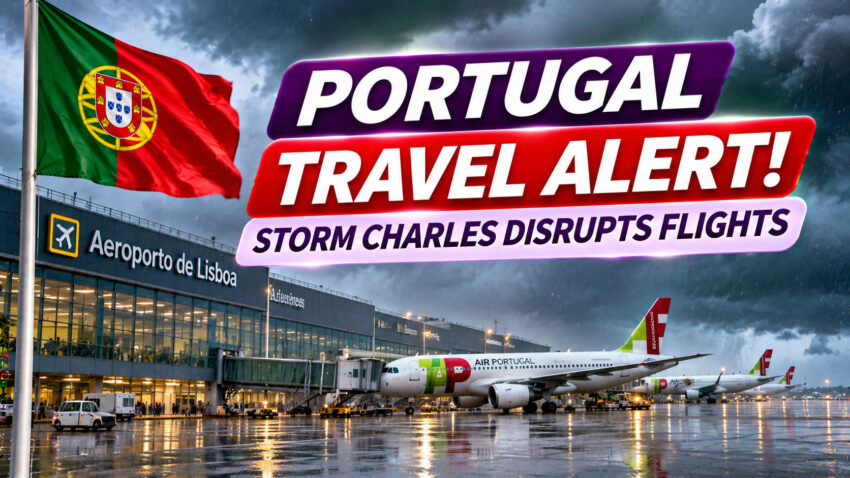
The situation has affected airports, public services and transport networks. More than 220 flights were reported cancelled at Lisbon and Faro airports during the morning of 11 November.
The Portuguese Government has also introduced temporary emergency measures, including school closures and restrictions on outdoor activities.
For international visitors, this is an important travel update.
Here is what is happening, which areas are affected and what passengers should do.
1. Why has Portugal declared a nationwide alert?
The Portuguese Government declared a state of alert for mainland Portugal from midnight until 23:59 on 11 November 2026.
The decision followed forecasts of severe weather associated with Storm Charles.
The Portuguese Institute for Sea and Atmosphere (IPMA) warned of:
- Periods of intense rain.
- Strong winds and powerful gusts.
- Potential flooding.
- Falling trees and infrastructure damage.
- Dangerous conditions around coastal areas.
- Possible disruption to electricity and communication networks.
Wind gusts were forecast to reach 120 km/h in some areas, with the possibility of exceeding 150 km/h if a particularly dangerous weather phenomenon known as a sting jet developed.
The authorities advised residents to avoid unnecessary journeys and follow official safety instructions.
2. More than 220 flights cancelled at Lisbon and Faro airports
One of the most significant consequences for international travellers has been disruption to air travel.
According to Portuguese public broadcaster RTP, more than 220 flights had been cancelled at Lisbon and Faro airports by approximately 09:20 local time on 11 November.
The reported breakdown was:
- Lisbon Airport: 208 cancellations.
- Faro Airport: 14 cancellations.
These figures reflect the reported situation at that time and may change as airlines update their schedules.
The Portuguese Civil Aviation Authority (ANAC) confirmed that it was monitoring the effects of the adverse weather on aviation operations.
It specifically highlighted possible disruption involving:
- Airport departure and arrival slots.
- Flight cancellations.
- Flight delays.
- Recovery of normal air traffic.
- Passenger-protection obligations.
The regulator also said that weather-related operational restrictions would be considered when assessing airlines’ compliance with relevant obligations.
3. Which Portuguese airports should travellers check?
The reported cancellations were concentrated at Lisbon and Faro airports.
However, the wider weather situation also affects other parts of Portugal.
Travellers should monitor their departure and arrival airports, particularly if their journeys involve:
Lisbon Airport
The country’s main international airport, with significant reported cancellations.
Faro Airport
An important gateway for visitors travelling to the Algarve.
Madeira Airport
Severe weather has also affected Madeira, particularly exposed and mountainous areas.
Porto Airport
Passengers should check directly with their airline for any changes to scheduled services.
An airport being open does not guarantee that every scheduled flight will operate.
4. TAP Air Portugal offers free flight changes
TAP Air Portugal issued a travel notice covering adverse weather conditions on 10 and 11 November.
The airline said passengers holding tickets issued by 10 November for travel up to 11 November could change their bookings to flights operating up to 17 November without a penalty.
The change is subject to the airline’s stated conditions, including remaining in the same travel cabin.
Passengers should check their individual booking and contact TAP or their travel agent before making changes.
Other airlines may have different arrangements.
Do not assume that every airline offers the same free-change policy.
5. Schools and public services temporarily closed
The Government introduced several emergency measures for 11 November.
These include:
- Closure of public, private and social-sector educational establishments.
- Closure of non-essential public services.
- Suspension of outdoor events.
- Restrictions on access to certain wooded and flood-prone areas.
- Restrictions around coastal areas and waterways.
- Increased readiness of emergency and rescue services.
The measures were intended to reduce risks to residents and visitors during the period of severe weather.
Travellers visiting Portugal should check whether their planned attractions, appointments and public services are operating.
6. Which parts of Portugal are at risk?
The alert applies across mainland Portugal.
The weather system has also affected Madeira and Porto Santo.
Areas exposed to strong winds, heavy rainfall and coastal conditions face particular risks.
Travellers should pay attention to:
Lisbon and surrounding areas
Heavy rain and strong winds can affect road travel, airport access and public transport.
Algarve
Visitors should monitor conditions around Faro and coastal destinations.
Madeira and Porto Santo
Mountainous and exposed areas may experience particularly dangerous weather.
Northern and central Portugal
Local flooding, falling trees and road disruption may affect journeys.
The exact impact can vary considerably by location and throughout the day.
7. What should tourists do if they are already in Portugal?
If you are currently visiting Portugal, follow local authority instructions and avoid unnecessary journeys during dangerous weather.
Here are some practical precautions:
Check your flight
Visit your airline’s website or app before travelling to the airport.
Contact your hotel
Ask whether local transport, excursions or airport transfers are operating normally.
Avoid coastal areas during dangerous conditions
Strong winds and rough seas can make coastal walks and viewpoints unsafe.
Do not drive through floodwater
Flooded roads can be deeper and more dangerous than they appear.
Monitor official weather warnings
Check IPMA and the European MeteoAlarm service for updated warnings.
Keep your travel documents accessible
Save your flight confirmation, booking reference and travel insurance details.
8. Are passengers entitled to compensation for cancelled flights?
Passengers travelling from Portugal should understand that severe weather can affect their rights under European air-passenger rules.
Under EU Regulation 261/2004, airlines generally have obligations to provide assistance and, where applicable, reimbursement or rerouting when flights are cancelled.
However, extraordinary circumstances such as severe weather may exempt airlines from paying additional financial compensation.
This does not automatically remove every passenger right.
Depending on the circumstances, passengers may still be entitled to:
- Reimbursement or rerouting.
- Meals and refreshments during qualifying waiting periods.
- Hotel accommodation where an overnight stay is necessary.
- Transport between the airport and accommodation where applicable.
The exact rights depend on the circumstances and the applicable passenger-protection rules.
Passengers should retain receipts and written communications from their airline.
9. Will Portugal remain affected after 11 November?
The Government’s nationwide alert measures described above were scheduled to remain in force until 23:59 on 11 November.
However, the end of that formal alert period does not automatically mean all travel services will immediately return to normal.
Airlines may need time to reorganise cancelled flights and reposition aircraft.
Roads, rail services and public facilities may also require inspections or repairs.
Travellers departing on 12 November and later should continue checking updated forecasts, airport information and airline notices.
10. Official websites to check before travelling
Use official sources for the latest information:
Portuguese weather service (IPMA)
Check weather warnings and forecasts:
https://www.ipma.pt/
Portuguese Civil Aviation Authority (ANAC)
Check aviation-related announcements:
https://www.anac.pt/
ANA Airports of Portugal
Check airport information and flight status:
https://www.ana.pt/
TAP Air Portugal
Check flight updates and booking changes:
https://www.flytap.com/
European MeteoAlarm
Check weather warnings across Europe:
https://www.meteoalarm.org/
Final Thoughts
Storm Charles has created a significant travel disruption in Portugal on 11 November 2026.
The Government declared a nationwide alert for mainland Portugal, while airports, airlines and public services introduced precautionary measures.
More than 220 flight cancellations were reported at Lisbon and Faro airports during the morning, and TAP Air Portugal announced a free-change option for eligible passengers.
If you are travelling to Portugal today or in the coming days, check your flight directly with your airline and follow official weather warnings.
Are you travelling to Portugal this week? Have you experienced any flight delays or cancellations? Share your experience in the comments.
Official Sources
- Portuguese Government — Nationwide alert declared for 11 November 2026
- Portuguese Civil Aviation Authority (ANAC) — Weather alert communication to aviation operators, 10 November 2026
- RTP — Storm Charles: More than 220 flights cancelled at Lisbon and Faro
- TAP Air Portugal — Flight alerts and information for 10–11 November
- UK Government — Portugal travel advice and severe weather warning
Disclaimer: This article is for general travel information. Weather conditions and transport operations can change quickly. Flight cancellation figures are time-specific reports and may change. Always confirm your booking and follow the instructions of airlines and local authorities.