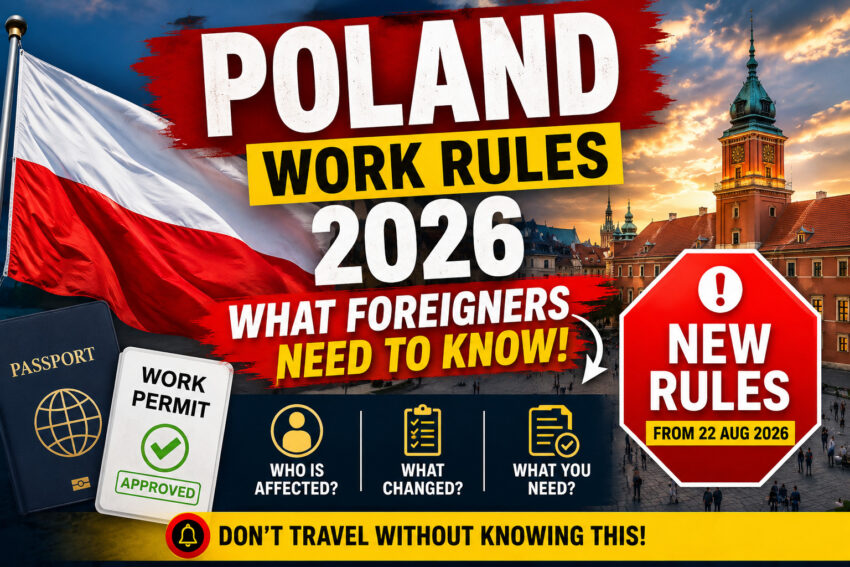

🚨 Poland Changes Work Rules for Foreigners in 2026: What You Need to Know
A new change in Poland’s employment rules is affecting how certain foreign nationals can work in the country.
For people considering Poland as a destination for employment, understanding the difference between visa-free travel and legal permission to work is becoming increasingly important.
Poland has been tightening controls around migration and employment, with authorities focusing on making legal employment more regulated and reducing misuse of visa-free entry. (Gov.pl)
🇵🇱 What Changed?
From 22 August 2026, citizens of Georgia, Colombia and Venezuela can no longer rely on visa-free travel alone to take up employment in Poland under the previous arrangement.
For these nationals, having a Polish work permit does not by itself make visa-free entry sufficient for employment. They generally need an appropriate visa or another residence document that permits them to work.
This is an important distinction:
✈️ Visa-free entry ≠ automatic right to work
Being allowed to enter Poland without a visa for a short stay does not necessarily mean that a person can legally begin employment.
👷 Who Is Affected?
The latest change specifically concerns citizens of:
Georgia
Colombia
Venezuela
The change is particularly relevant to people who previously planned to enter Poland using visa-free travel and then take up employment based on a work permit.
Poland’s broader migration policy has increasingly focused on controlling labour migration and preventing misuse of employment and visa procedures. (Gov.pl)
📅 What About People Already Working?
There are transitional provisions.
People from the affected countries who had already started working before 22 August 2026 may be able to continue working under the applicable transitional rules until their visa-free stay expires.
This means the change does not necessarily terminate every existing employment arrangement immediately.
However, workers should carefully check their individual status and the documents that authorise both their stay and employment.
🛂 Why Is Poland Making These Changes?
Poland has been working to strengthen its migration and employment system.
The country adopted its 2025–2030 migration strategy, which places greater emphasis on controlled and predictable migration, labour-market needs, border management and reducing abuses within immigration procedures. (Gov.pl)
Poland has also previously introduced measures aimed at preventing visa misuse and regulating employment by foreign nationals.
The latest change therefore fits into a wider shift toward more controlled labour migration.
💼 Does This Mean Poland Is Closing Its Labour Market?
No.
Poland continues to employ foreign workers and remains an important destination for international labour migration.
The key change is that foreign workers need to make sure they have the correct immigration status for employment.
For someone planning to work in Poland, the process should therefore be viewed as:
Job opportunity → Work authorisation → Appropriate visa/residence status → Legal employment
rather than:
Visa-free entry → Work permit → Start working
⚠️ An Important Lesson for Foreign Workers
One of the biggest mistakes international applicants make is treating a work permit and a visa as the same thing.
They are not necessarily the same.
A work permit generally relates to the right to perform specified employment, while immigration permission determines whether and how a person can legally remain in Poland.
Depending on nationality and circumstances, additional immigration documentation may be required.
What About Other Foreign Workers?
The August 2026 change specifically concerns citizens of Georgia, Colombia and Venezuela.
It does not mean that every foreign national suddenly faces the same rule.
Requirements can differ depending on:
- 🌍 Nationality
- 💼 Type of employment
- 📄 Work authorisation
- 🛂 Visa status
- 🏠 Residence status
- 📅 Date of entry
- 🇵🇱 Individual circumstances
This is why applicants should always check the rules that apply to their own nationality and situation.
🔍 What Should You Do Before Going to Poland for Work?
If you’re considering Poland for employment, don’t simply book a flight after receiving a job offer.
✅ Check your work authorisation
Make sure the employer has completed the appropriate procedure.
✅ Check your immigration status
Confirm whether you need a national visa or another residence document.
✅ Check your nationality-specific rules
Visa-free arrangements are not identical for every nationality.
✅ Check the latest Polish requirements
Immigration and employment regulations can change, so information from an old Facebook post or video may no longer be accurate.
✅ Confirm everything before travelling
The safest approach is to make sure you have the correct documents before entering Poland for employment.
Could Other European Countries Follow Similar Policies?
European countries are increasingly looking at ways to balance labour shortages with stronger control over migration.
Poland’s approach is particularly relevant because the country has experienced substantial foreign-worker migration while simultaneously strengthening its migration-management framework. Its national migration strategy explicitly focuses on more controlled and predictable migration. (Gov.pl)
That doesn’t mean other countries will automatically introduce identical rules.
But it does highlight a broader trend:
Europe is becoming more selective about how foreign workers enter and access its labour markets.
🚨 What This Means for People Planning to Work in Poland
If Poland is on your list of potential European work destinations, the latest change is a reminder to check your complete immigration pathway before travelling.
A job offer is important.
A work permit is important.
But having the correct immigration status to legally work and remain in Poland is equally important.
The Bottom Line
Poland’s latest change means certain nationals can no longer rely on the previous combination of visa-free entry + work permit to take up employment.
For citizens of Georgia, Colombia and Venezuela, the rules changed from 22 August 2026, with transitional arrangements for some people already working before that date.
For everyone else, the key lesson remains the same:
Before travelling to Europe for work, check both your work authorisation AND your immigration status.
💬 What Do You Think?
🇵🇱 Would stricter work-visa rules make you reconsider working in Poland?
👍 Yes
🤔 Maybe
❌ No
Tell us which European country you’d choose for work in 2026. 👇
This article is for general information and is not legal advice. Immigration and employment rules can change. Applicants should verify the latest requirements with Polish authorities before travelling or accepting employment.
Poland’s official government information portal
A good next step for today’s content would be a short Facebook post + eye-catching Poland immigration thumbnail based on this article.