
EU Labour Mobility 2026: New Proposals Could Make Working Across Europe Easier
Working in another European country could become simpler for millions of people if the European Union moves forward with new labour mobility measures. From recognising professional qualifications to improving digital social-security procedures, proposed changes could help workers navigate employment opportunities across EU member states.
For skilled professionals, jobseekers, cross-border commuters and people considering relocating for work, these developments are worth following. However, there is an important distinction: a proposal to simplify working across Europe is not the same as a new rule that is already legally in force.
This guide explains the reported EU labour mobility initiative, the areas of reform to watch, what the changes could mean for workers and employers, and what people planning to work in Europe should do now.
What Is the EU Fair Labour Mobility Package?
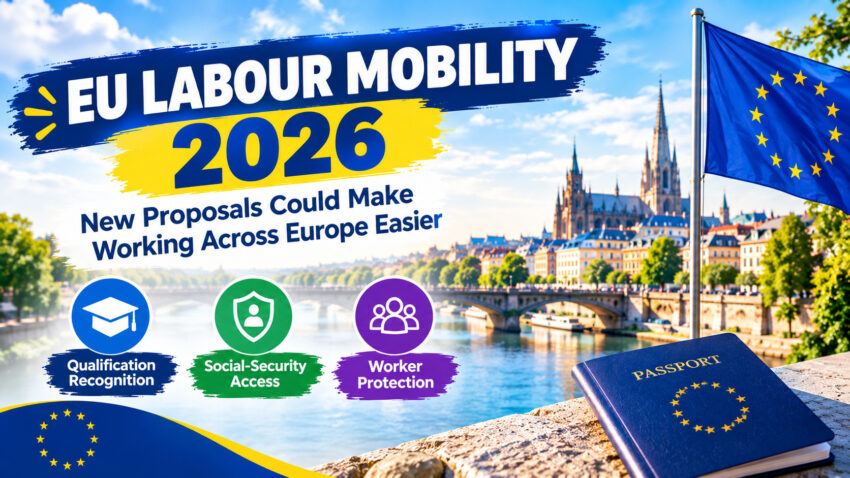
On 15 September 2026, the European Commission announced its Fair Labour Mobility package, a set of proposed reforms intended to make it easier to work across EU countries, verify qualifications, prove social-security rights and enforce labour protections. The package includes a policy communication and five legislative proposals. 【turn985836search0】
The proposals address a practical problem: workers moving between European countries can face different qualification-recognition procedures, paperwork requirements and administrative systems.
The Commission wants to improve how national authorities and employers exchange information, while making it easier for workers to demonstrate their skills and access the social-security documents they need.

1. Easier recognition of professional qualifications
Proposed digital procedures and updated rules aim to help qualified professionals have their credentials assessed more efficiently when moving to another EU country.

2. Digital social-security documents
The proposed European Social Security Pass would allow people to request, store and present documents digitally, including the European Health Insurance Card and the A1 document for posted workers.

3. Stronger worker protection
The package proposes strengthening the European Labour Authority’s ability to support cross-border enforcement, inspections, cooperation between national authorities and dispute resolution.
Source: European Commission, Fair Labour Mobility package, September 2026. 【turn985836search1】
1. Recognition of Qualifications Could Become Easier
One of the main challenges for people seeking employment abroad is getting their qualifications understood and, where necessary, formally recognised.
A degree, professional certificate or vocational qualification may need to be checked by the relevant authority before its holder can work in certain occupations. Requirements can differ depending on the country, the profession and where the qualification was obtained.
The Commission’s proposed Skills Portability Initiative aims to make these procedures more consistent and digital.
What could change?
Digital qualification credentials that are easier to verify.
Better comparisons between qualifications awarded in different countries.
More streamlined procedures for regulated professions.
Clearer deadlines and less repetitive documentation.
Common approaches to assessing certain qualifications obtained outside the EU.
The initiative also proposes extending automatic recognition to additional regulated professions, beginning with physiotherapists through a common training framework adopted as part of the September package. 【turn985836search2】
Which workers could benefit?
Potentially affected groups include:
Doctors, nurses and other healthcare professionals.
Engineers and teachers.
Physiotherapists and other regulated professionals.
Skilled technical workers.
Employers recruiting people with overseas qualifications.
Important: Recognition of a qualification does not automatically guarantee a job. Employers may still require relevant experience, language skills, professional registration or other conditions.
2. Digital Social-Security Procedures
Social-security paperwork can become complicated when someone lives in one EU country and works in another, or when an employer temporarily sends an employee abroad.
The proposed European Social Security Pass, known as ESSPASS, is intended to make it easier to request and verify relevant documents electronically. 【turn985836search3】
Which documents are involved?
European Health Insurance Card (EHIC)
Used by eligible people to access medically necessary state-provided healthcare during a temporary stay in another participating European country, under the applicable conditions.
Portable document A1
Establishes which country’s social-security legislation applies to a worker in relevant cross-border situations, including certain temporary postings.
What could this mean for workers?
If the proposal becomes law and the relevant systems are implemented, workers could spend less time requesting paper documents, chasing administrative offices and proving their social-security status.
Employers could also benefit from more standardised processes when sending staff to work temporarily in another member state.
However, digital documents would not create new healthcare or benefit entitlements by themselves. Eligibility would continue to depend on the relevant rules and the individual’s circumstances.
3. Stronger Protection for Workers Moving Across Borders
Labour mobility is not only about finding a job in another country. It also involves ensuring that workers receive the protections they are entitled to.
The Commission proposes strengthening the European Labour Authority’s role in helping national authorities cooperate, coordinate inspections and address cross-border disputes. 【turn985836search4】
Areas of concern include:
Incorrect or unclear employment arrangements.
Problems involving posted workers.
Employers failing to meet applicable labour obligations.
Difficulties resolving disputes that involve more than one country.
Fraud involving social-security documents or employment arrangements.
The aim is to make existing protections easier to enforce across national borders.
This does not mean that every employment dispute would automatically be handled by a single EU authority. National authorities would continue to play important roles under the applicable legal framework.
4. What About Qualifications Obtained Outside the EU?
This is a particularly relevant part of the package for people who earned their degrees or professional certificates outside the European Union.
The Commission has proposed common rules intended to simplify the recognition of certain qualifications held by non-EU nationals. It aims to make assessments more transparent and reduce unnecessary differences between national procedures. 【turn985836search5】
For example, a nurse, engineer or other qualified professional educated outside the EU may need to demonstrate that their training meets the requirements for practising in a particular European country.
Under the proposed approach, some eligible qualifications could benefit from more consistent assessments, digital documentation and, where the specified conditions are met, automatic recognition.
Nevertheless, several distinctions matter:
A foreign degree is not automatically recognised throughout the EU.
Regulated professions can have additional education, registration or language requirements.
Recognition for employment purposes is different from admission to a university or other educational institution.
Immigration permission and professional qualification recognition are separate processes.
For non-EU jobseekers, the key point is that qualification recognition may become easier, but it is not a new EU-wide work permit.
5. Proposed Changes vs Rules Already in Force
The package was announced in September 2026, but the proposals should not be treated as fully implemented rules.
The European Commission states that the main benefits will begin once the relevant initiatives are adopted by the European Parliament and the Council and the measures enter into force. 【turn985836search0】
Area | Position in September 2026 |
|---|---|
Existing EU free movement rights | Already apply to eligible EU citizens under existing law and conditions. |
Recognition of regulated professional qualifications | Existing EU and national procedures remain applicable while proposed revisions are considered. |
Digital Social Security Pass | Proposed; new procedures depend on adoption and implementation. |
Digital qualification credentials | Proposed changes; rollout is expected to be phased. |
Recognition of certain non-EU qualifications | Common EU-level rules have been proposed; the relevant national requirements still matter. |
Stronger European Labour Authority powers | Proposed changes; implementation depends on the legislative process. |
The Commission’s published implementation outline anticipates that some changes to the recognition of non-EU qualifications could follow within two years of adoption, while digital qualifications and easier recognition for regulated professions could follow within three years. These are proposed implementation timelines, not a guarantee that every measure will start on a fixed date. 【turn985836search1】
6. When Could the New Measures Start?
There is no single start date for every element of the package.
The proposals must go through the EU legislative process, and individual measures may have different implementation periods.
The Commission has outlined a phased approach:
First stage: Adoption of the relevant legislation and preparation for implementation.
Social-security documents: The proposed A1 digitalisation would begin one year after the relevant ESSPASS Regulation enters into force, with the EHIC and other documents following within three years.
Qualification recognition: Proposed changes for non-EU qualifications could be implemented within two years of adoption.
Digital qualifications and regulated professions: Further changes are envisaged within three years of adoption.
European Labour Authority: Changes to its mandate could be implemented progressively, with improvements anticipated over 2028–2030.
These timings are based on the Commission’s published plans and remain dependent on the legislative process. 【turn985836search0】
Travellers and jobseekers should therefore check official national guidance rather than assuming that a proposed deadline is already an operative rule.
7. What Does This Mean for People Planning to Work in Europe?
The practical effect will depend on your nationality, qualifications, occupation and intended destination.
If you have a university degree
Keep your degree certificate, transcripts, course descriptions and any required professional registrations available. Check whether your intended occupation is regulated in the destination country.
If you work in healthcare
Check the destination country’s licensing, language and qualification-recognition requirements. Do not assume that a foreign healthcare qualification grants immediate permission to practise.
If you are a non-EU jobseeker
Research the work visa or residence permit route, employer sponsorship requirements where applicable, and professional recognition rules separately.
If you are an employer
Monitor the legislative process and continue following the existing employment, posting-of-workers and social-security rules until any new measures become applicable.
Can non-EU citizens apply for jobs in any EU country under these proposals?
No new general right to work across the EU is created by the proposals alone. Non-EU nationals generally need to meet the immigration and work-authorisation requirements that apply to their situation and destination country.
Qualification recognition may help an applicant meet professional requirements, but it does not replace a visa or residence permit where one is required.
8. Will All EU Countries Apply the Changes at the Same Time?
Not necessarily.
The purpose of the package is to make certain processes more consistent across the EU. However, the legislation must first be adopted, and some measures will require national authorities to update their systems and procedures.
The implementation timetable also differs by policy area. That means workers and employers should check the status of the particular measure relevant to them instead of assuming that all countries will introduce every change simultaneously.
The Commission’s official package page provides updates and links to the proposed legislation:
.
Frequently Asked Questions (FAQs)
1. What is EU Labour Mobility 2026?
It refers to the European Commission’s September 2026 Fair Labour Mobility package, which proposes changes to qualification recognition, digital social-security procedures and cross-border labour enforcement.
2. Are the new EU labour mobility rules already in force?
The package was proposed in September 2026. Its legislative measures require adoption and implementation before the relevant new rules can apply. Existing laws continue to govern in the meantime.
3. Will it become easier to work in another EU country?
The proposals aim to reduce administrative barriers and simplify certain procedures. The actual effect will depend on the legislation adopted, the profession involved and the worker’s circumstances.
4. Will foreign qualifications be recognised automatically?
Not all of them. The package proposes common rules and expanded automatic recognition in specified circumstances. Eligibility and professional requirements will still matter.
5. Can people from Pakistan use these changes to work in Europe?
People with Pakistani nationality may potentially benefit from relevant qualification-recognition procedures if they meet the applicable conditions. However, the proposals do not automatically grant Pakistani citizens EU work rights, visas or residence permits.
6. What is the European Social Security Pass?
It is a proposed digital system intended to help people request, store and present social-security documents, including the A1 document and the European Health Insurance Card.
7. When will the changes take effect?
There is no single date for the entire package. Implementation depends on the adoption of the relevant measures and their individual timelines.
Final Thoughts
The EU’s September 2026 Fair Labour Mobility package proposes changes that could make cross-border employment administration more digital, improve the recognition of qualifications and strengthen cooperation on workers’ rights.
For skilled professionals and people planning to work abroad, these developments are worth monitoring. However, the proposals should not be confused with rules that are already in force. Existing immigration requirements, professional licensing rules and social-security arrangements remain important until the relevant changes are adopted and implemented.
Before accepting a job or moving to another European country, verify the latest requirements with the destination country’s official authorities and the relevant professional-recognition body.