
Germany Border Controls 2026: What Travelers, Students & Workers Need to Know
Germany is continuing temporary border controls at its internal borders — but what does this actually mean for people traveling, studying, or working in the country?
If Germany is on your travel or immigration plans, this is an update worth knowing before you cross the border.
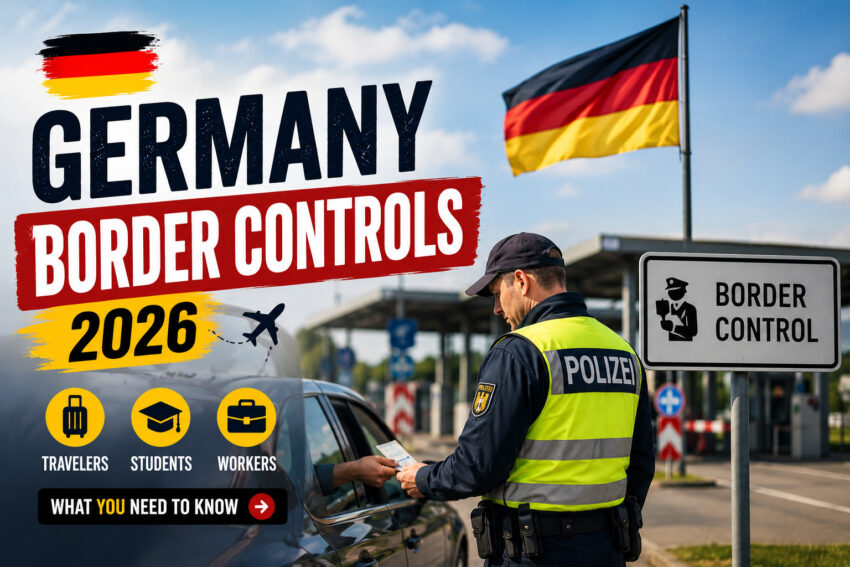
Germany has notified the European Commission that its temporary internal border controls will continue from September 16, 2026, until March 15, 2027. The controls apply to Germany’s land borders with several neighboring countries.
But there is an important point many headlines can make confusing:
Germany Is NOT Closing Its Borders
Germany remains part of the Schengen Area.
Temporary internal border controls are different from permanently closing a country’s borders or leaving Schengen.
Under Schengen rules, countries can temporarily reintroduce checks at internal borders in certain exceptional circumstances.
Germany’s current notification refers to concerns including irregular migration, migrant smuggling, pressure on the asylum system, and security developments.
So if you’re planning to visit Germany, don’t assume that you won’t be able to enter.
Instead, be prepared for possible checks.
🛂 Which German Borders Are Affected?
The latest notification covers Germany’s land borders with:
France
Luxembourg
Belgium
Netherlands
Denmark
Austria
Switzerland
Czechia
Poland
This is particularly important for people who regularly cross Germany’s borders by car, train or bus.
🚗 What Could Travelers Experience?
Temporary border controls don’t necessarily mean every traveler will be stopped.
However, authorities can carry out checks, meaning travelers should be prepared to show their required documents.
This could affect people traveling for:
✈️ Holidays
🚆 Weekend trips
🎓 Education
💼 Work
👨👩👧 Family visits
🚗 Cross-border commuting
If you’re traveling through several European countries, it’s also worth checking the border-control situation for your entire route.
🪪 What Documents Should You Carry?
If you’re crossing into Germany, make sure you have the documents relevant to your situation.
For example:
- 🛂 Valid passport
- 🇪🇺 Residence permit, if applicable
- 🎓 Student residence documentation
- 💼 Work/residence documentation
- 🛃 Valid visa, where required
For non-EU travelers, having the correct immigration documents is particularly important.
Remember:
A Schengen visa allows travel under specific conditions — it does not remove all border-entry requirements.
🎓 What Does This Mean for International Students?
If you’re studying in Germany, the temporary controls do not mean that international students cannot enter or leave Germany.
However, students traveling outside Germany should make sure they carry their passport and valid residence documentation.
For example, a student living in Germany who travels to France or Poland may encounter checks when returning to Germany.
📌 Simple advice:
Don’t travel internationally without the documents proving your legal status.
💼 What About Foreign Workers?
Foreign workers should also understand the difference between border controls and work authorization.
Temporary border checks do not automatically cancel a person’s German residence or work rights.
But workers must still have the appropriate permission to live and work in Germany.
This is especially relevant for people who:
- Work near the German border
- Commute between countries
- Travel regularly for business
- Live in one Schengen country and work in another
Germany–Poland Border Could Be Especially Important
The Germany–Poland border is included in Germany’s latest temporary-control notification.
That could matter to:
🇵🇱 Polish workers commuting to Germany
🇩🇪 German workers traveling into Poland
🎓 Students
🚗 Road travelers
🚌 Bus passengers
👨👩👧 Families visiting across the border
Poland has also introduced temporary controls on parts of its borders during 2026, so travelers using this route should check the latest information before departure.
What About France?
France is another important example.
France has its own temporary internal border-control arrangements, including controls involving its border with Germany.
That means someone traveling France → Germany may encounter checks depending on the current arrangements and circumstances.
This is why travelers should not assume that:
“It’s Schengen, so there will never be a border check.”
Temporary controls can change that situation.
❓ Will Every Traveler Be Checked?
Not necessarily.
Temporary border controls give authorities the ability to conduct checks.
They do not mean that every person crossing the border will automatically experience the same procedure.
The practical experience can depend on:
- Border location
- Travel route
- Mode of transportation
- Current operational arrangements
- Individual circumstances
So don’t panic — just be prepared.
🚨 5 Things You Should Know Before Traveling
1️⃣ Germany is still in Schengen
The temporary controls do not mean Germany has left the Schengen Area.
2️⃣ Borders are not permanently closed
Travel between Germany and neighboring countries remains possible under the applicable rules.
3️⃣ Checks may happen
You could be asked to show your passport or other documents.
4️⃣ Non-EU travelers should be particularly careful
Make sure your visa or residence status is valid for your circumstances.
5️⃣ Check before you travel
Border-control arrangements can change, so don’t rely on an old social-media post.
🌍 Is Germany the Only European Country Doing This?
No.
Germany is currently one of several Schengen countries using temporary internal border controls.
Countries can have different:
- Start dates
- End dates
- Borders affected
- Reasons for the controls
So if you’re planning a road trip across Europe, it’s a good idea to check the situation for each country on your route.
🔮 What Could This Mean for European Travel?
The return of temporary internal border checks highlights an important change for travelers:
Schengen does not always mean zero border checks.
The free-movement system remains in place, but temporary controls can be introduced when countries consider them necessary under the relevant rules.
For frequent travelers, international students and cross-border workers, this makes travel planning and document checks more important than ever.
Should You Cancel Your Germany Trip?
Not simply because of the border-control announcement.
If you have a legitimate reason to travel and the appropriate documents, temporary controls don’t automatically mean you cannot enter Germany.
Instead:
✅ Check your documents
✅ Check your visa/residence status
✅ Check your route
✅ Allow some extra time
✅ Check official information before departure
The Bottom Line
Germany’s temporary internal border controls are scheduled to continue from:
September 16, 2026 → March 15, 2027
The controls cover Germany’s land borders with France, Luxembourg, Belgium, the Netherlands, Denmark, Austria, Switzerland, Czechia and Poland.
But this does not mean Germany is leaving Schengen or permanently closing its borders.
For travelers, students and workers, the message is simple:
Don’t panic. Be prepared.
Carry the documents you need, understand your immigration status, and check the latest border information before traveling.
💬 What Do You Think?
🇩🇪 Would temporary border checks change your plans to travel to Germany?
👍 No, I’d still travel
🤔 I’d check first
❌ I’d postpone my trip
Comment your choice below 👇
This article is for general information only and is not legal or immigration advice. Border-control arrangements can change. Always verify the latest information with official German and European authorities before traveling.
Source: European Commission — Schengen Area: Temporary Reintroduction of Border Control.