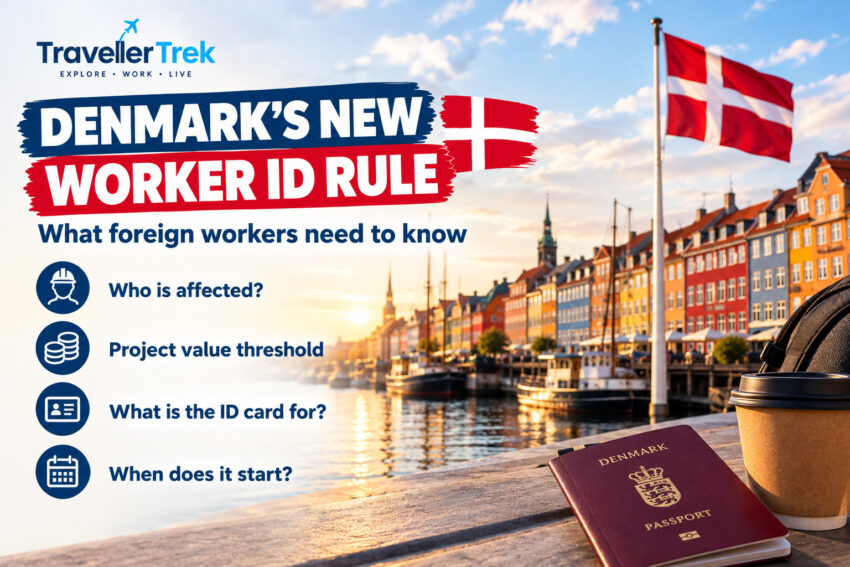

Denmark New Worker ID Requirement 2026: What Foreign Workers Need to Know
Denmark has adopted a new ID-card requirement for workers on large construction sites, including rules designed to make it easier for authorities to identify workers and check whether employment is taking place legally.
The new law was adopted by the Danish Parliament on 3 September 2026. However, the rules have not entered into force yet, so workers and companies do not need to obtain the new ID cards immediately. The implementation date and technical details are still being prepared.
The change is particularly relevant to people working in Denmark’s construction sector, including foreign workers and employees of foreign companies.
What Is Denmark’s New Worker ID Card?
Under the new law, people working on certain large construction and civil-engineering projects will have to carry a personal ID card while on the construction site.
The requirement applies to projects with a total construction value of more than DKK 100 million.
The purpose is to make it easier for Danish authorities to establish:
- Who is working on a construction site
- Which company they work for
- What role they perform
- Whether required qualifications are in place
- Whether employment and registration requirements are being followed
The Danish Ministry of Employment and Gender Equality says the measure is intended to strengthen controls and combat exploitation of foreign labour and social dumping.
👷 Who Will Need an ID Card?
The requirement is aimed at people who work on construction sites covered by the law.
This can include workers employed by Danish companies as well as workers connected to foreign companies operating in Denmark.
The legislation provides that everyone who is present on a covered construction site for work must carry an ID card, subject to specific exceptions. People who are not working there or who are only visiting briefly, such as delivery personnel, can instead be registered as visitors and carry a visitor card.
🌍 Why Is Denmark Introducing the Requirement?
The Danish government says the new system is intended to improve control over working conditions and help combat:
- Illegal employment
- Exploitation of foreign workers
- Social dumping
- Unfair competition
- Non-compliance with labour regulations
The ID card is also intended to make it easier for authorities to identify the companies and individuals working on large construction projects.
🏗️ Which Construction Projects Are Covered?
The law applies to construction and civil-engineering projects with a total project value of more than DKK 100 million.
This is important because the requirement is not a general ID-card rule for every worker in Denmark.
If someone works in another industry, or on a construction project below the legal threshold, the new requirement does not automatically apply simply because they are employed in Denmark.
🪪 What Information Will the ID Card Contain?
According to information published by Danish business representatives following adoption of the law, the personal ID card is expected to contain information such as:
- Name
- Photograph
- Nationality
- Work function
- Required qualifications
- Employer’s CVR number
- RUT number where applicable
The card may be physical or digital depending on how the final system is implemented.
What Does This Mean for Foreign Workers?
For foreign workers considering employment in Denmark’s construction sector, the new system is particularly relevant.
The ID-card system is designed to help authorities check whether people working on covered construction sites have the necessary legal employment or work arrangements.
The legislation also gives Danish authorities additional powers to request ID cards for checks involving residence and work permits.
This means foreign workers should continue to make sure that their:
passport + residence/work permission + employment registration + required qualifications
are in order.
The new ID card does not replace a Danish residence or work permit.
What About Workers From Other EU Countries?
The ID-card requirement is not itself a new visa system.
EU/EEA workers and workers from outside the EU can still be subject to different immigration and employment rules depending on their nationality and circumstances.
The new requirement is primarily a worksite identification and compliance measure for covered construction projects.
Foreign companies providing services in Denmark may also have obligations under Denmark’s Register of Foreign Service Providers (RUT) system. Danish authorities explain that foreign companies providing services in Denmark generally have registration obligations under RUT, with specific rules depending on the activity.
⚠️ The Rules Are Not Active Yet
This is the most important point for workers and employers right now.
Although Parliament has adopted the law, the new ID-card requirements are not currently in force.
Danish business organisation Dansk Erhverv says the implementation date has not yet been determined. Technical requirements and the necessary IT system still need to be developed.
So workers should not assume that they need to obtain a new Danish construction ID card immediately.
The authorities are expected to provide further information before the requirements become operational.
📋 What Should Foreign Workers Do Now?
If you are already working in Denmark or planning to work there, there is no need to panic.
Instead:
1. Check your work permission
Make sure you have the correct residence and work permission for your situation.
2. Check your employer
Make sure you know which Danish or foreign company officially employs you.
3. Keep your documents available
Keep your passport, residence permit and other relevant employment documents accessible.
4. Check whether your project is covered
The new requirement is specifically connected to construction and civil-engineering projects above the DKK 100 million threshold.
5. Wait for the official implementation details
The final system and start date have not yet been established.
❓ Does Every Foreign Worker in Denmark Need This ID?
No.
The new requirement is not a general ID card for every foreign worker living or working in Denmark.
It specifically concerns people working on covered large construction and civil-engineering projects.
Someone working in hospitality, IT, healthcare, education or another sector is not automatically covered by this particular construction-site ID-card law.
❓ Is This a New Work Visa?
No.
The ID card is not a replacement for a Danish work permit or residence permit.
It is intended to help identify workers and employers on covered construction sites and support authorities’ labour-market inspections.
Foreign workers must still comply with the immigration and employment rules applicable to their nationality and circumstances.
📌 Denmark Worker ID Requirement at a Glance
| Question | Current information |
|---|---|
| Has the law been adopted? | ✅ Yes |
| Adoption date | 3 September 2026 |
| Is it already in force? | ❌ No |
| Who is mainly affected? | Workers on covered large construction sites |
| Project threshold | Over DKK 100 million |
| Does it apply only to foreigners? | ❌ No |
| Does it replace a work permit? | ❌ No |
| Can foreign workers be affected? | ✅ Yes |
| Implementation date | Not yet confirmed |
What This Means for People Planning to Work in Denmark
For people considering Denmark as a work destination, particularly in construction, this is a development worth following.
The government says the new system is intended to strengthen oversight of working conditions and make it easier to identify workers and companies operating on large construction projects.
For foreign workers, the practical lesson is to make sure that employment, residence and work-permission requirements are properly arranged before starting work.
The new ID card will become an additional part of the compliance system once the law enters into force.
Final Takeaway
Denmark has adopted a new mandatory ID-card system for workers on large construction and civil-engineering projects worth more than DKK 100 million.
The measure is intended to strengthen labour-market controls, make it easier to identify workers and companies, and help authorities combat illegal employment and exploitation of foreign labour.
However, the requirement is not active yet.
The implementation date and technical details still need to be established, so workers should wait for official instructions rather than assuming they need to apply for an ID card immediately.
For anyone planning to work in Denmark’s construction sector, especially foreign workers, this is a rule worth keeping on your radar.
Official Sources
- Danish Ministry of Employment — Law adopted (3 September 2026): Official announcement
- ⚖️ Danish Parliament / Retsinformation — Adopted law text: Official legislation
- 📋 Retsinformation — Original bill and details of the ID-card requirements: Bill details
- 🏢 Dansk Erhverv — Practical information for businesses: ID-card re
- Danish Ministry — Bill introduced: Government bill announcement.