
Germany Healthcare Recognition Rules 2026: New Changes for Foreign Doctors, Nurses and Pharmacists
Introduction
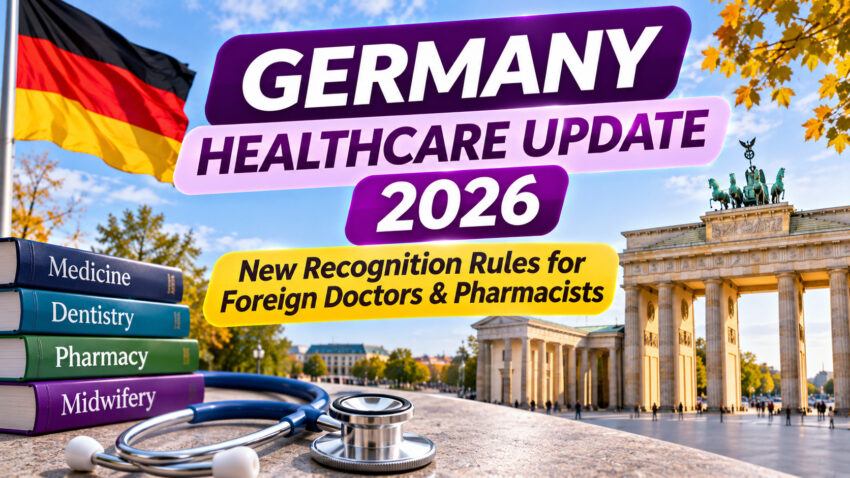
Germany has introduced important changes to the recognition of foreign healthcare qualifications, creating a revised process for internationally trained doctors, dentists, pharmacists and midwives.
The new rules are part of the country’s efforts to simplify professional recognition, reduce administrative delays and make it easier for qualified international professionals to enter the German healthcare workforce.
The main changes under the new legislation took effect on 1 November 2026.
One of the most important developments is that a direct knowledge examination is now generally the standard recognition route for doctors, dentists and pharmacists who obtained their professional qualifications outside the EU, European Economic Area and Switzerland. A document-based equivalence assessment remains available as an option.
For international applicants considering Germany, understanding these changes is essential before beginning a recognition or visa application.
Here is what has changed and what applicants need to know.
1. What changed from 1 November 2026?
Germany’s new legislation is designed to make the recognition of foreign healthcare qualifications more consistent and efficient.
The changes cover several healthcare professions, including:
- Doctors
- Dentists
- Pharmacists
- Midwives
The main changes include:
- Direct knowledge examinations becoming the standard route for doctors, dentists and pharmacists with qualifications from third countries.
- Document-based equivalence assessments remaining available as an optional route.
- Greater use of electronic communication and digital procedures.
- New arrangements for assessing language skills.
- More flexible recognition options for internationally trained midwives.
The objective is to reduce unnecessary administrative work while maintaining Germany’s professional standards and patient-safety requirements.
2. New recognition process for foreign doctors
One of the most significant changes concerns doctors who completed their medical education outside the EU, EEA and Switzerland.
Under the new framework, the direct knowledge examination (Kenntnisprüfung) generally becomes the standard route for professional recognition.
Previously, applicants could face extensive document-based assessments to determine whether their medical education was equivalent to German standards.
Under the revised approach, applicants can choose the document-based equivalence assessment instead of the standard direct examination route.
The knowledge examination is intended to assess professional competence against the required German standards.
What this means for international doctors:
- Applicants should prepare for the possibility of a professional knowledge examination.
- The examination is not simply a test of identified gaps in an individual applicant’s education.
- The assessment applies professional licensing standards.
- Applicants must still meet the relevant language and licensing requirements.
Passing the examination does not automatically remove every other requirement for practising medicine in Germany.
3. Changes for foreign dentists
Dentists who obtained their qualifications outside the EU, EEA and Switzerland are also affected.
The revised framework generally makes the direct knowledge examination the standard recognition route, while retaining the option of a document-based equivalence assessment.
Applicants should prepare for the possibility of demonstrating their professional knowledge according to German requirements.
Depending on the competent authority and individual application, additional documentation, language evidence and licensing steps may be necessary.
International dental graduates should therefore identify the responsible authority in the German federal state where they intend to work.
4. New recognition arrangements for pharmacists
Foreign-trained pharmacists are also included in the changes.
The direct knowledge examination generally becomes the standard route for recognising pharmaceutical qualifications obtained in third countries.
Applicants can still choose the document-based equivalence assessment.
The process is intended to establish whether an applicant meets the professional requirements for practising pharmacy in Germany.
International pharmacists should carefully review:
- Their university qualification.
- Academic transcripts.
- Professional registration in their country of training.
- Required German-language proficiency.
- The applicable examination and licensing arrangements.
A foreign pharmacy degree alone does not automatically authorise someone to work as a licensed pharmacist in Germany.
5. What changes for internationally trained midwives?
The revised legislation introduces additional flexibility for foreign-trained midwives.
Applicants with qualifications from third countries can choose to waive the document-based equivalence assessment.
They can then proceed directly through one of the available routes:
- A knowledge examination.
- An adaptation course.
This gives applicants another way to demonstrate or develop the professional competencies required for recognition.
The appropriate route depends on the individual circumstances and the competent authority’s requirements.
6. Germany introduces more digital recognition procedures
Another important part of the reform is the increased use of electronic communication.
The legislation provides for electronic transmission of information and documents between authorities.
This can help reduce administrative delays and make communication between the responsible bodies more efficient.
The changes also support more consistent procedures across Germany’s federal states.
However, digitalisation does not mean every applicant can complete the entire process instantly or without submitting supporting documents.
Applicants should still follow the instructions of the authority responsible for their profession and location.
7. Can foreign healthcare professionals apply from outside Germany?
Yes. Internationally trained healthcare professionals can begin researching and preparing their recognition applications while living abroad.
The first step is to identify the competent recognition authority for the intended profession and German federal state.
Applicants should determine which documents are required and whether they need a professional knowledge examination, document-based assessment or another recognition measure.
For Pakistani applicants, the German Missions in Pakistan also publish guidance for certain visa categories connected with recognition measures.
For example, the German Consulate General in Karachi lists the following key requirements for its recognition-measure visa guidance:
- An assessment notice from a competent German authority, such as a Defizitbescheid or Zwischenbescheid.
- A suitable qualification programme in Germany.
- German-language proficiency at A2 level under the CEFR.
Important: This particular checklist applies to applications handled by the German Consulate General in Karachi. Applicants handled by the German Embassy in Islamabad should follow the Consular Services Portal and its relevant instructions.
8. Is there a visa that allows applicants to work while completing recognition?
Germany offers a route called the Recognition Partnership.
This arrangement allows eligible international professionals to enter Germany and complete the recognition process with the support of their employer while working at the same time.
Applicants generally need:
- A foreign academic or vocational qualification requiring at least two years of full-time training.
- A qualification recognised by the country where it was obtained.
- A concrete job offer from a suitable German employer.
- A written recognition partnership agreement with the employer.
- German-language skills at least at A2 level.
There are additional requirements, particularly for regulated healthcare professions.
For example, doctors and nursing professionals may need a professional licence before carrying out regulated duties. Under the applicable arrangements, some applicants may work in an assistant capacity while completing the required licensing process.
The recognition partnership is not an automatic visa entitlement. Applicants must meet the relevant immigration and employment conditions.
9. What documents should applicants prepare?
The exact document list depends on the profession, qualification and responsible recognition authority.
However, applicants may commonly need:
- A valid passport.
- Medical or professional degree certificate.
- Academic transcripts and subject details.
- Evidence of professional registration or licence, where applicable.
- Employment and professional experience certificates.
- Curriculum vitae.
- German-language certificates.
- Certified translations where required.
- Additional documents requested by the competent authority.
Applicants should not assume that one document checklist applies to every healthcare profession.
It is important to obtain the official requirements before paying for translations, certifications or examination arrangements.
10. Does this mean Germany is offering automatic jobs to foreign doctors?
No.
The new legislation changes aspects of professional recognition. It does not automatically provide employment, a work visa or permission to practise.
Applicants must still satisfy the relevant conditions.
These can include:
- Professional qualification recognition.
- Required German-language proficiency.
- Passing the relevant examination or completing an adaptation measure.
- Obtaining the necessary professional licence.
- Meeting the requirements of the relevant visa or residence permit.
A successful recognition outcome can improve an applicant’s ability to pursue qualified employment, but it does not guarantee a job offer.
11. What should Pakistani healthcare professionals do next?
For Pakistani doctors, dentists, pharmacists and midwives interested in Germany, preparation should begin with the recognition process rather than an assumption that a visa is the first step.
A practical approach is:
Step 1: Identify the German profession that matches your qualification.
Step 2: Find the responsible recognition authority through the official Recognition Finder.
Step 3: Review the applicable examination and document requirements.
Step 4: Prepare your academic certificates, transcripts and professional records.
Step 5: Check the German-language requirements for your profession.
Step 6: Explore suitable employers and relevant visa options.
Step 7: Follow the official German Embassy or Consulate instructions for your place of application.
Starting with the correct recognition authority can help applicants avoid unnecessary applications and expenses.
Final Thoughts
Germany’s healthcare qualification recognition reform is an important development for internationally trained medical professionals.
Since 1 November 2026, the revised framework has introduced a more standardised approach to recognition for doctors, dentists, pharmacists and midwives with qualifications from outside the EU, EEA and Switzerland.
The direct knowledge examination is now generally the standard route for doctors, dentists and pharmacists, while document-based assessment remains an option. Midwives also have additional flexibility in their recognition process.
For international applicants, including those from Pakistan, the opportunity is worth exploring, but preparation is essential.
Professional recognition, language requirements, licensing and immigration rules must all be considered before moving to Germany.
Would you consider moving to Germany to build a career in healthcare? Tell us your profession and your thoughts in the comments!
Official Sources
- German Federal Ministry of Health — Law to accelerate recognition procedures for foreign healthcare qualifications
- Recognition in Germany — Recognition of healthcare professions: New rules
- Make it in Germany — Recognition of foreign professional qualifications
- Make it in Germany — Visa for a Recognition Partnership
- German Missions in Pakistan — Recognition measure for a foreign qualification
Disclaimer: This article is for general information and immigration awareness. Recognition and licensing requirements vary by profession and German federal state. Applicants should verify the latest requirements with the competent recognition authority and German diplomatic mission before applying.