
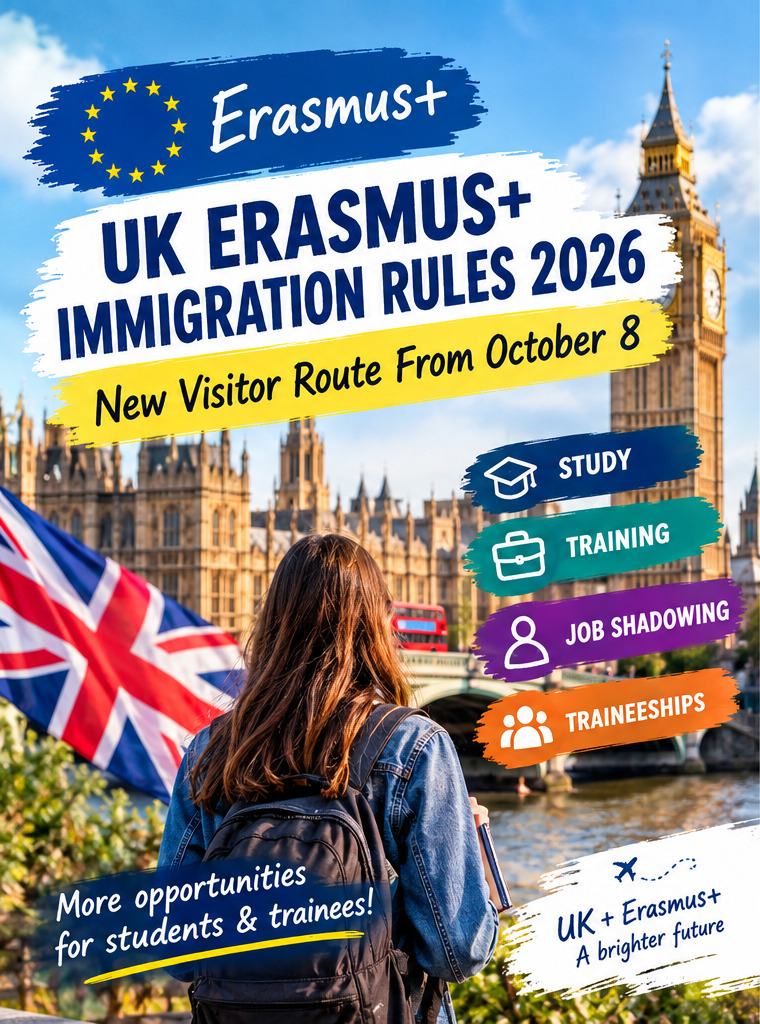

UK Erasmus+ Immigration Rules 2026: New Opportunities for Students and Trainees
The UK is preparing to rejoin Erasmus+ from 2027, and new immigration rules coming into force on 8 October 2026 are designed to make it easier for eligible Erasmus+ participants to study, train and take part in mobility activities in the UK.
The changes cover the Visitor, Student, Child Student and Government Authorised Exchange routes, creating several immigration options depending on the type of Erasmus+ activity. GOV.UK
What is changing?
The UK and European Union agreed that the UK would associate with the Erasmus+ programme from 2027. The new Immigration Rules are being introduced to prepare the UK’s immigration system for that participation. GOV.UK
From 8 October 2026, eligible Erasmus+ participants will have specific activities recognised under UK immigration rules.
These include:
- study and educational activities
- training
- traineeships
- job shadowing
- skills competitions
- coaching and sports training
- teaching and other eligible mobility activities
The exact immigration route will depend on the activity and the participant’s circumstances.
🎓 Can Erasmus+ students study in the UK?
Yes.
The new rules specifically allow eligible Erasmus+ participants to undertake courses at participating UK institutions.
For some activities, participants may use the Visitor route, while other programmes can qualify under the Student or Child Student routes. GOV.UK
This is important because some Erasmus+ courses do not necessarily lead to a traditional UK qualification.
The new Student route provisions allow eligible Erasmus+ students to be sponsored for certain programmes even where the course would previously have fallen outside the normal Student route requirements.
✈️ Erasmus+ activities allowed under the Visitor route
One of the biggest changes is the creation of a specific section for Erasmus+ activities under the Visitor route.
Eligible participants may be able to:
📚 Receive or provide training
Participants can receive or provide training at a UK organisation or educational institution participating in Erasmus+.
The activity cannot simply be used to fill a permanent job position in the UK. GOV.UK
💼 Undertake a traineeship
Participants aged 18 or under can undertake an eligible Erasmus+ traineeship in the UK for up to 30 days, subject to the relevant conditions.
Under-18 participants must also provide appropriate permission from their parent or legal guardian and home institution. GOV.UK
👀 Take part in job shadowing
The rules also recognise Erasmus+ job shadowing.
This allows participants to follow practitioners and observe how an organisation operates, while gaining skills and knowledge.
However, job shadowing must not amount to taking up a permanent position. GOV.UK
⚽ Sports coaching and training
Sports staff, coaches and volunteers can also undertake eligible coaching or training assignments at UK sports organisations under Erasmus+. GOV.UK
🏫 What about schools?
The changes also make it possible for eligible Erasmus+ participants to undertake certain short-term study placements at UK state-funded schools and academies.
The government says these placements can last for up to six months, subject to the applicable requirements. GOV.UK
This could create additional opportunities for international students and young people participating in Erasmus+ mobility projects.
🧑🎓 What happens to work placements?
The new rules also make special provisions for Erasmus+ students undertaking courses that include work placements.
Normally, UK Student route rules place restrictions on how much of a course can consist of a work placement.
The new rules exempt eligible Erasmus+ participants from those work-placement duration restrictions. GOV.UK
This could be particularly relevant for Erasmus+ programmes combining study and practical workplace experience.
🛂 Do Erasmus+ participants automatically get a UK visa?
No.
The new rules do not mean every Erasmus+ participant automatically receives permission to enter the UK.
Participants still have to meet the requirements of the immigration route they are using.
For example, people using the Visitor route for Erasmus+ activities must demonstrate that they are genuinely participating in an eligible Erasmus+ mobility project. GOV.UK
The appropriate route can depend on:
- the type of Erasmus+ programme
- length of stay
- type of activity
- age of the participant
- UK institution involved
- whether sponsorship is required
📅 When do the new rules start?
The key date is:
8 October 2026
The relevant Immigration Rules changes take effect from this date.
The UK government also states that applications made before 8 October 2026 that fall under the specified provisions will generally be decided according to the rules in force before the changes take effect. GOV.UK
Why is this important for Europe?
The UK has not participated in Erasmus+ since leaving the programme following Brexit.
Its planned association with Erasmus+ from 2027 represents a major change in UK-European educational mobility.
The UK government says the new immigration changes are intended to facilitate that participation and allow eligible Erasmus+ activities to operate through several existing immigration routes. GOV.UK
For European students, young people, educators and organisations, this could create new opportunities to include the UK in future Erasmus+ mobility projects.
⚠️ Important: This is not a general UK study visa change
This update should not be interpreted as a new route allowing anyone to study or work in Britain without the appropriate immigration permission.
The changes specifically relate to eligible Erasmus+ activities.
If someone wants to move to the UK for a normal university degree, long-term employment or another activity outside Erasmus+, they will still need to follow the immigration rules applicable to that route.
📌 What should Erasmus+ participants do?
If you’re planning an Erasmus+ opportunity involving the UK:
1. Check your programme
Confirm that your activity is officially part of an eligible Erasmus+ mobility project.
2. Identify the correct immigration route
Do not assume that every Erasmus+ activity uses the Visitor route.
3. Check your UK institution
Make sure the UK organisation or educational institution is participating in the relevant programme.
4. Prepare supporting documents
You may need evidence showing your participation in the Erasmus+ project and, in certain circumstances, confirmation from your home institution.
5. Check the rules before travelling
UK immigration requirements can depend on nationality, activity and length of stay.
🔎 TravellerTrek takeaway
The UK’s planned return to Erasmus+ in 2027 is bringing important immigration changes earlier.
From 8 October 2026, the UK Immigration Rules will specifically recognise a wider range of Erasmus+ activities, including training, study, traineeships, job shadowing and sports activities.
For European students and young people looking for international study and training opportunities, this could make the UK a much more accessible part of future Erasmus+ mobility programmes.
The important date to remember: 8 October 2026.
Official source
UK Government — Statement of Changes to the Immigration Rules