
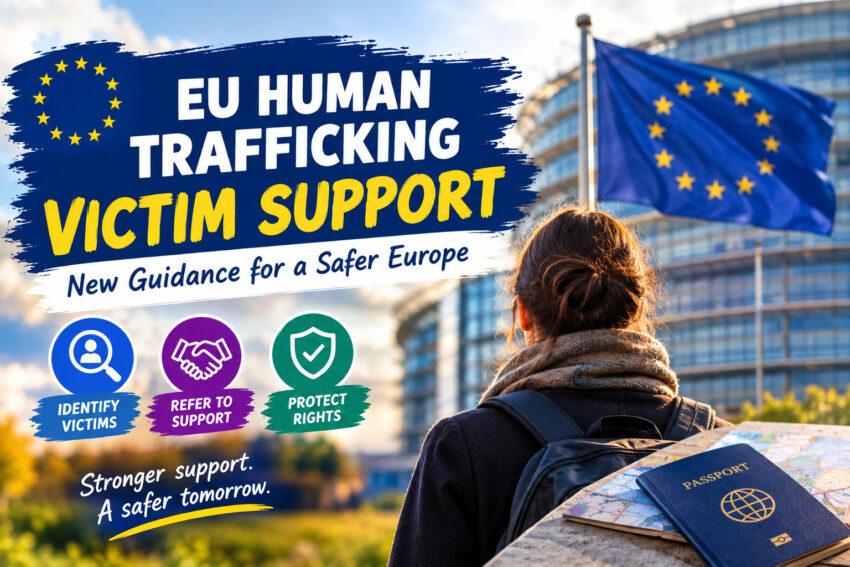

EU Human Trafficking Victim Support 2026: New Guidance for Identifying and Protecting Victims
On September 28, 2026, the European Commission published a new policy paper examining how EU countries identify potential victims of human trafficking and connect them with appropriate support services.
The paper reviews national referral mechanisms across all 27 EU member states. These mechanisms bring together public authorities, support organisations and civil society groups to help identify victims, coordinate assistance and improve protection.
The update is relevant to migration and worker protection because people experiencing exploitation may have difficulty finding help, particularly when they face language barriers, insecure employment or uncertainty about their immigration status.
What is a national referral mechanism?
A national referral mechanism is a system through which authorities and relevant organisations identify potential victims of human trafficking and refer them to appropriate assistance.
Depending on the country and the person’s circumstances, support may involve social services, specialist organisations, healthcare professionals, law enforcement or legal assistance.
The purpose is to help potential victims reach the services they need rather than leaving them to navigate complex systems alone.
What did the European Commission publish?
The European Commission’s policy paper, produced through the EU Anti-Trafficking Hub, maps and analyses referral mechanisms across the EU.
It examines how countries organise victim identification, referrals, support and cooperation between institutions.
The paper also highlights areas where further work is needed, including:
- Identifying less visible forms of trafficking
- Improving access to long-term support
- Strengthening cross-border referral arrangements
- Improving monitoring and data collection
- Clarifying the responsibilities of organisations involved
These are findings and recommendations from the policy paper, not a new residence-permit programme.
Why can victims be difficult to identify?
Human trafficking can involve different forms of exploitation. Some situations are not immediately visible to people outside the victim’s circumstances.
A person may be controlled through threats, deception, withheld wages, debt, restricted movement or other forms of coercion. In labour exploitation, a worker may be afraid to report abuse because they depend on an employer for income, housing or information about their immigration status.
Not every workplace dispute is trafficking. The circumstances must be assessed by the relevant authorities and qualified support organisations.
Recognising possible warning signs can nevertheless help people seek assistance earlier.
What support does the EU want to strengthen?
The policy paper recommends improvements to the systems that identify and assist victims.
1. Earlier identification
Authorities and frontline professionals need to recognise less visible forms of trafficking, including labour exploitation and child trafficking.
2. Better coordination
Clearer responsibilities can help public authorities and civil society organisations coordinate referrals and support.
3. Access to assistance
The recommendations emphasise access to immediate support for victims, including non-EU nationals, regardless of whether they cooperate with law enforcement.
The precise services and legal protections available depend on the applicable EU and national rules.
4. Cross-border cooperation
When a potential victim moves between countries, organisations may need to coordinate referrals and support. Clearer procedures can help prevent people from being lost between different systems.
5. Monitoring and evaluation
Better data and monitoring can help countries understand whether their systems identify victims effectively and provide the support required.
What does this mean for non-EU workers and migrants?
The paper does not create a new visa, work permit or automatic residence status. Its focus is on the identification, referral and protection of trafficking victims.
However, it highlights an important practical issue: people who experience exploitation should not assume that they have no options simply because they are foreign nationals.
If someone is being threatened, controlled or exploited, they can seek help from appropriate local support organisations or competent authorities. In an immediate emergency, contact the emergency services in the country where they are located.
If you are unsure which service to contact, the European Commission’s anti-trafficking resources provide country-specific information and links to relevant authorities.
What should someone do if they suspect exploitation?
If you believe that you or another person may be experiencing human trafficking:
- Prioritise immediate safety and avoid confronting a suspected trafficker if doing so could increase danger.
- Contact emergency services if there is an immediate threat.
- Seek guidance from an official support service or a reputable organisation that assists trafficking victims.
- Keep relevant information only if it is safe to do so.
- Ask for a qualified interpreter or legal assistance where needed.
People should not put themselves at risk to gather evidence. Specialist organisations can advise on safer next steps.
What happens next?
The Commission’s policy paper provides an updated assessment and recommendations as EU countries continue implementing the revised Anti-Trafficking Directive.
The recommendations include strengthening formal referral mechanisms, clarifying responsibilities, improving training and ensuring that victims can access appropriate support.
The publication itself does not mean that all member states have already implemented every recommendation. National systems and available services can differ, so people should check the guidance applicable to the country concerned.
Final thoughts
The new EU policy paper focuses on a crucial part of migration and worker protection: identifying people who may be experiencing trafficking and helping them reach support.
For migrants and workers, the practical message is that exploitation should not be ignored because of nationality or uncertainty about immigration status. Appropriate local support services can explain the available protections and options.
For the latest information, use official EU resources and country-specific support contacts.
Official sources
European Commission — A new policy paper explores the role of National Referral Mechanisms across the EU:
EU Anti-Trafficking Hub:
This article provides general information and is not legal advice. Available assistance and legal protections depend on the country and individual circumstances.