
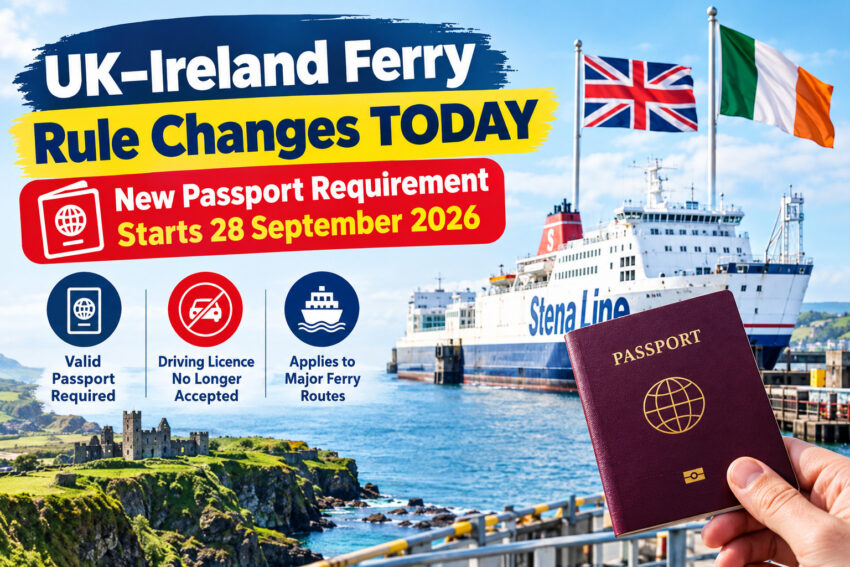

UK–Ireland Ferry Rule Changes TODAY: New Passport Requirement Starts 28 September 2026
Published: 28 September 2026
If you are travelling by ferry between Great Britain and the Republic of Ireland, there is an important documentation change starting today, 28 September 2026.
Passengers using several major ferry routes must now carry a valid passport before boarding. The change affects both British and Irish citizens, as well as passengers of other nationalities, on the affected services. (Dublin Port)
🚢 What Has Changed?
From 28 September 2026, passengers travelling on the affected Britain–Ireland ferry routes are required to present a valid passport at check-in.
Previously, some ferry operators accepted alternative forms of photographic identification, such as driving licences. Those alternatives are no longer accepted on the affected routes. (Stena Line)
This is an important distinction: the Common Travel Area (CTA) between Britain and Ireland remains in place. The new requirement concerns the documentation ferry operators require for boarding and passenger-data purposes. (GOV.UK)
📍 Which Ferry Routes Are Affected?
The new requirement applies to major crossings between Great Britain and the Republic of Ireland, including:
Irish Ferries
- Dublin ↔ Holyhead
- Rosslare ↔ Pembroke
Irish Ferries says passengers must present a valid passport or Irish passport card, and other forms of ID are not accepted on these services. (Irish Ferries)
Stena Line
- Dublin ↔ Holyhead
- Rosslare ↔ Fishguard
Stena Line says passengers travelling through Dublin, Holyhead, Fishguard or Rosslare on the relevant services must present a valid passport from 28 September. (Stena Line)
🪪 Can You Use a Driving Licence Instead?
No — not on the affected ferry services.
Driving licences and other alternative photo IDs that may previously have been accepted are no longer sufficient under the new ferry boarding requirements. (Dublin Port)
For Irish citizens, an Irish passport card is accepted by Irish Ferries, while travellers should check the specific operator’s current requirements before travelling. (Irish Ferries)
What About British and Irish Citizens?
This is where the change can be confusing.
The Common Travel Area has not been abolished. British and Irish citizens continue to benefit from the CTA arrangements between the two countries. (GOV.UK)
However, ferry operators are now requiring passengers on the affected international routes to provide passport documentation at boarding.
In other words:
CTA travel rights remain — but ferry boarding documentation has become stricter.
What About EU and Other International Travellers?
For travellers who are not British or Irish citizens, normal immigration and visa requirements still apply.
Stena Line states that EU citizens travelling to the UK generally need a passport and may also need a UK Electronic Travel Authorisation (ETA) if they are eligible to travel without a visa. Other nationalities should check whether they need a visa or ETA. (Stena Line)
If your journey involves both Ireland and the UK, remember that permission to enter one country does not automatically replace the requirements for the other.
Important for Pakistani Travellers
If you are travelling from Pakistan and planning an itinerary involving Ireland and the UK, do not assume that the ferry rule is the only requirement.
You should check:
- Your passport validity
- Whether you need an Irish visa
- Whether you need a UK visa or ETA, depending on your circumstances
- Whether your ferry operator requires additional documentation
- That the name and personal details on your booking match your travel documents
Stena Line specifically advises passengers to make sure booking information matches the photographic ID presented at check-in. (Stena Line)
🗺️ Does This Affect Northern Ireland?
The new rule is about ferry services between Great Britain and the Republic of Ireland.
It should not be confused with travel across the Ireland–Northern Ireland land border. The UK government continues to recognise the Common Travel Area, and there are no routine immigration controls on the land border between Ireland and Northern Ireland. (GOV.UK)
Stena Line also says its services involving Belfast, Liverpool, Cairnryan and Heysham are not affected by this particular change. (The Independent)
⚠️ What Happens If You Arrive Without the Required Passport?
The practical risk is being unable to board.
Irish Ferries says that from 28 September, passengers on its affected routes must have the required passport documentation and that other forms of ID will not be accepted. (Irish Ferries)
That means travellers should check their documents before leaving home, rather than discovering the problem at the port.
✅ Ferry Travel Checklist for 2026
Before travelling between Britain and Ireland:
☑️ Check that your passport is valid
☑️ Take the passport required by your ferry operator
☑️ Don’t rely on a driving licence as your only ID
☑️ Check visa requirements for your nationality
☑️ Check whether a UK ETA applies to you
☑️ Make sure your booking details match your passport
☑️ Check the ferry company’s latest travel information
☑️ Arrive at the port with enough time for check-in
🚨 The Bottom Line
The biggest change starting today, 28 September 2026, is straightforward:
Passengers on the affected Great Britain–Republic of Ireland ferry routes should carry the required valid passport documentation before boarding.
The change applies even to British and Irish citizens on these services, although their underlying Common Travel Area rights remain unchanged. (Dublin Port)
If you’re travelling today or in the coming weeks, check your ferry operator’s documentation requirements before heading to the port.