
EU Fair Labour Mobility Package 2026: What Could Change for Workers in Europe?
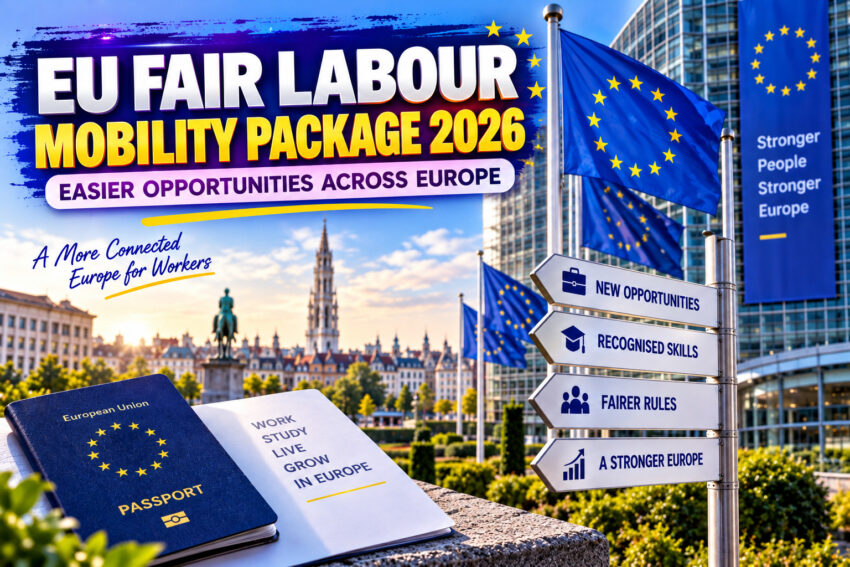
The European Commission has introduced a new Fair Labour Mobility Package aimed at making it easier for people to work across European Union countries.
Announced on 15 September 2026, the package focuses on professional qualifications, social-security documents, cross-border employment and stronger protection for workers.
The proposals could eventually make it easier for workers to move between EU countries and for employers to recruit people from across Europe. However, the measures still need to go through the European Parliament and the Council before they become EU law.
💼 What Is the Fair Labour Mobility Package?
The package contains a communication and five legislative proposals covering social security, professional qualifications, skills portability and enforcement.
The European Commission says the objective is to make social rights and professional skills easier to use across borders while reducing administrative procedures for workers, businesses and national authorities.
The proposals include:
- 🇪🇺 A European Social Security Pass
- 🎓 A new Skills Portability Act
- 📜 Updated professional-qualification recognition rules
- 🌍 New rules for qualifications obtained outside the EU
- 🛡️ Stronger powers for the European Labour Authority
🪪 1. European Social Security Pass
One of the most notable proposals is the European Social Security Pass (ESSPASS).
Under the proposed system, people would be able to request and receive important social-security documents online.
These could include:
- European Health Insurance Cards
- Portable A1 documents for posted workers
- Other documents proving social-security rights
The documents could be stored and presented through the EU Digital Identity Wallet, while national authorities would be able to verify them digitally.
The Commission says this could reduce paperwork, speed up verification and help prevent fraudulent documents.
🎓 2. Faster Recognition of Professional Qualifications
Another major part of the package concerns professional qualifications.
Today, workers moving between EU countries can face different national procedures for having their qualifications recognised.
The Commission proposes a more digital and standardised system.
For regulated professions such as doctors, nurses, engineers and teachers, the proposed system would introduce a mandatory digital process and binding deadlines.
The Commission says recognition could become considerably faster, with some procedures taking up to five weeks instead of several months.
Automatic recognition would also be extended to additional regulated professions, beginning with physiotherapists.
🌍 3. What About People With Non-EU Qualifications?
This part could be particularly relevant to international workers.
The Commission is proposing common rules for recognising qualifications obtained outside the EU, including qualifications held by third-country nationals.
The aim is to make these procedures more predictable and reduce differences between national systems.
The Commission says procedures that currently take an average of around 14 months could be reduced to around four months under the proposed framework.
For some professions where EU-wide training standards already exist, qualifications from accredited institutions outside the EU could potentially qualify for automatic recognition if they meet the proposed conditions and are reviewed through European quality-assurance arrangements.
However, an important point is that qualification recognition is not the same as an immigration visa or work permit.
EU countries would continue to control admission to their territory and the conditions for practising regulated professions.
📱 4. Digital Qualifications
The Commission also wants qualifications to become easier to verify digitally.
Under the proposal, new and existing qualifications could be issued in a standardised digital format and made available through the EU Digital Identity Wallet.
An EU-level comparison tool would also help employers and workers understand qualifications obtained in different countries.
This could be particularly useful when someone applies for a job in another EU country and the employer needs to understand their education or professional training.
🛡️ 5. Stronger Protection for Cross-Border Workers
The package also proposes strengthening the European Labour Authority (ELA).
The Commission wants the authority to have better tools for:
- Cross-border labour inspections
- Cooperation between national authorities
- Resolving disputes
- Identifying risks
- Supporting workers and employers
- Tackling undeclared work and labour abuses
The proposed changes would also expand cooperation concerning some third-country nationals working in the EU.
👷 Who Could Benefit?
The proposals could be relevant to several groups, including:
EU citizens working abroad
People moving from one EU country to another could face fewer administrative obstacles when proving qualifications or social-security rights.
🎓 Skilled professionals
Doctors, nurses, engineers, teachers, physiotherapists and other regulated professionals could benefit from faster recognition procedures.
🌍 Non-EU professionals
People with qualifications from outside the EU could eventually benefit from clearer and more consistent recognition procedures.
🏢 Employers
Companies could have easier access to qualified workers from other countries and faster ways to verify qualifications.
📊 Why Is the EU Proposing These Changes?
The European Commission says around 14 million Europeans lived in another EU country in 2024, including more than 10 million people of working age.
At the same time, skills shortages remain an issue across parts of the European labour market.
The Commission therefore wants workers’ qualifications and social-security rights to be more portable when they move between countries.
⚠️ Is This Already a New EU Work Visa?
No.
This is one of the most important points.
The Fair Labour Mobility Package is currently a set of proposals, not a new EU-wide work visa.
The proposals must be considered by the European Parliament and the Council before the main measures can enter into force. The EU’s current roadmap lists a target for agreement in Q3 2027.
The package also does not remove individual countries’ authority over immigration admission or national work-permit systems.
📅 What Happens Next?
The proposals will now move through the EU legislative process.
Implementation would also happen in stages.
According to the Commission:
- 🪪 Digital social-security documents would be introduced gradually.
- 📜 Simpler recognition of non-EU qualifications is planned within two years of adoption.
- 📱 Digital qualifications and easier recognition for regulated professions are planned within three years.
- 🛡️ Changes involving the European Labour Authority could produce improvements from around 2028–2030.
🌍 What Could It Mean for People Wanting to Work in Europe?
If adopted, the package could make some parts of the European job-mobility process more digital and predictable.
For workers, the biggest changes could involve qualification recognition, social-security documentation and cross-border employment procedures.
For international professionals, the proposed common framework for non-EU qualifications could also make it easier to understand how overseas qualifications are assessed.
But applicants would still need to meet the immigration, work-permit and professional-licensing requirements of the country where they want to work.
📌 Final Takeaway
The EU’s Fair Labour Mobility Package 2026 is designed to make working across European borders simpler by improving digital documentation, qualification recognition and worker protection.
The main proposals include:
💼 Easier cross-border labour mobility
🎓 Faster recognition of professional qualifications
🌍 New procedures for non-EU qualifications
🪪 Digital social-security documents
📱 EU Digital Identity Wallet integration
🛡️ Stronger enforcement of labour rules
However, these changes are proposals rather than rules already in force. The European Parliament and Council still need to consider the legislation.
For people planning to work in Europe, the development is worth watching as the legislative process continues.
Source: European Commission, Fair Labour Mobility Package, 15 September 2026.