

Schengen Student Visa Policy 2026: A Complete Guide for International Students
Published: July 2026
The Schengen Area remains one of the world’s most attractive destinations for international students, offering access to prestigious universities, affordable education in several countries, and the freedom to travel across 29 Schengen member states during studies. Every year, thousands of students from Pakistan, India, Bangladesh, Nigeria, and other countries choose Europe for higher education because of its globally recognized qualifications and diverse academic opportunities.
While the Schengen Area follows a common policy for short-stay visas, students planning to pursue degree programmes lasting longer than 90 days must apply under the national long-stay (Type D) student visa or residence permit rules of their chosen country. Each Schengen member state manages long-term student visas according to its own immigration laws, although many of the basic requirements are similar.
What Is a Schengen Student Visa?
A “Schengen Student Visa” generally refers to the national student visa or residence permit issued by a Schengen country for international students. Unlike the standard Schengen short-stay visa, which allows travel for up to 90 days within a 180-day period, students enrolled in degree programmes normally require a long-stay national visa (Type D) and, after arrival in many countries, a residence permit.
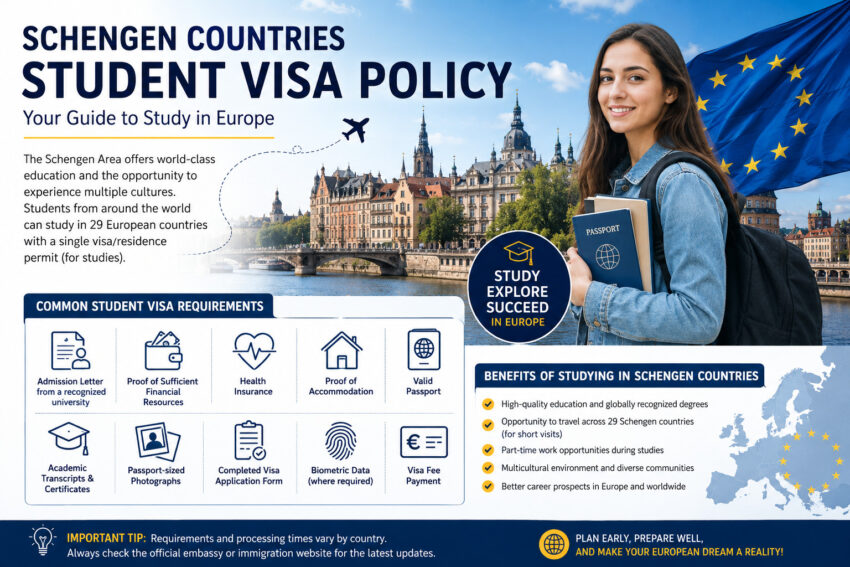
Common Student Visa Requirements
Although requirements vary slightly from country to country, most Schengen nations require applicants to provide:
- A valid passport
- An official admission letter from a recognized university
- Completed student visa application
- Proof of sufficient financial resources
- Health insurance covering the period of stay
- Academic transcripts and certificates
- Passport-sized photographs
- Proof of accommodation
- Payment of the applicable visa fee
- Biometric data (fingerprints and photograph), where required
Financial Requirements
One of the most important parts of any student visa application is demonstrating that you can financially support yourself throughout your studies.
Immigration authorities generally require evidence that you can cover:
- Tuition fees
- Accommodation costs
- Living expenses
- Health insurance
- Return travel, if required
Authorities increasingly verify the authenticity and source of funds, and applicants are encouraged to provide clear, consistent financial documentation.
Student Visa Processing
Processing times differ by country and season. During peak admission periods, applications may take several weeks or longer. Students are strongly advised to apply as soon as they receive an official university admission letter and have gathered all required documents.
Submitting incomplete applications or inaccurate financial information can lead to delays or refusals.
Can Students Travel Within the Schengen Area?
Yes. Once a student legally resides in a Schengen country under a valid residence permit or long-stay visa, they can generally travel to other Schengen countries for short visits (up to 90 days in any 180-day period), provided they continue to meet the relevant entry conditions. Long-term study authorization itself remains valid only in the country that issued it.
Top Schengen Countries for International Students
Some of the most popular Schengen destinations include:
- Germany
- France
- Sweden
- Finland
- Italy
- Netherlands
- Belgium
- Austria
- Denmark
- Norway
Each country has its own immigration procedures, financial thresholds, residence permit rules, and work regulations for international students. Applicants should always check the official immigration authority or embassy of their chosen destination before applying.
Tips for Pakistani Students
Pakistani students planning to study in Europe should begin preparing several months before their intended intake. Universities often issue admission letters well in advance, allowing applicants enough time to arrange finances, prepare supporting documents, and complete visa formalities.
Students should ensure that:
- All academic documents are genuine and complete.
- Financial records are accurate and verifiable.
- Their passport remains valid throughout the application process.
- They purchase the required health insurance before travelling.
- They attend biometric appointments and interviews, if requested.
Careful preparation and complete documentation significantly improve the chances of a successful application.
Conclusion
The Schengen Area continues to welcome talented international students and remains one of the world’s leading destinations for higher education. Although long-term student visas are governed by the national laws of each member country, applicants can expect similar core requirements, including university admission, financial proof, health insurance, and valid travel documents.
Students who prepare early, submit authentic documentation, and follow the official requirements of their chosen country are well positioned to begin their academic journey in Europe. As immigration policies can evolve, applicants should always rely on official government guidance for the latest visa procedures and requirements before submitting their applications.