
🚨 Sweden Offers Up to £27,000 to Some Foreign Residents to Leave — What You Need to Know
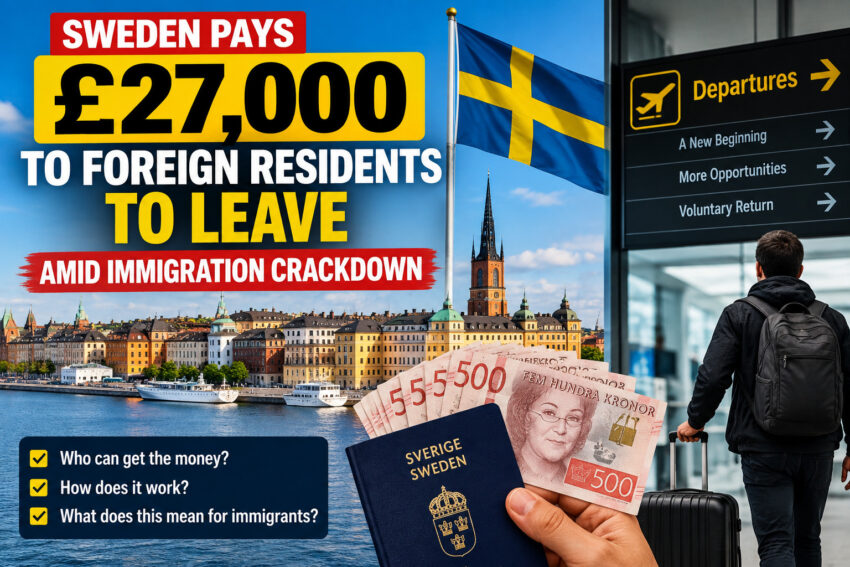
Sweden is taking a much tougher approach to immigration in 2026, and one of its most controversial policies is attracting international attention: eligible foreign residents can receive up to SEK 350,000 — roughly £27,000 — to voluntarily leave Sweden and return to a country where they have the right to live. (Reuters)
The policy comes as Sweden prepares for its September 13, 2026 general election, with immigration becoming a major political issue.
But there is an important detail behind the headline: the £27,000 payment is not available to every foreign resident in Sweden.
💷 How Much Is Sweden Offering?
Under rules introduced on January 1, 2026, the Swedish repatriation grant was substantially increased.
Eligible applicants can receive:
- 👤 SEK 350,000 per adult
- 👶 SEK 25,000 per child
- 👨👩👧 Up to SEK 500,000 for a couple
- 🏠 Up to SEK 600,000 per household
The Swedish Migration Agency says the money is intended to help people who voluntarily return to their home country or another country where they have the right to live. (Migrationsverket)
At current exchange rates, SEK 350,000 is around £27,000, although the exact pound value changes with currency rates.
⚠️ Who Can Actually Get the Money?
This is where the viral headline can be misleading.
The programme is aimed at people who have a residence permit in Sweden based on protection needs and who voluntarily choose to leave Sweden.
The Swedish Migration Agency says applicants must have the right to live in the country they intend to move to. The grant also cannot be used for settlement in another EU/EEA country or Switzerland. (Migrationsverket)
So this is not simply a scheme where any immigrant can collect £27,000 and leave Sweden.
Why Did Sweden Increase the Payment?
The Swedish government says the increased financial support is intended to make voluntary repatriation easier and provide people with financial assistance when starting again in their home country.
The grant had historically attracted very few applicants. The government therefore dramatically increased the amount in an attempt to make voluntary return more financially attractive. (Migrationsverket)
The government has allocated around SEK 1.3 billion to the programme. (Reuters)
📉 But Is the Scheme Actually Working?
So far, the response has been relatively limited.
According to Reuters, 171 people had accepted the offer during 2026 as of its September 8 report. That is a small number compared with the much larger foreign-born population in Sweden. (Reuters)
Critics argue that the policy may be more political than practical, suggesting that the financial incentive has not produced a large increase in voluntary departures.
Supporters, however, argue that people who genuinely want to return home should receive meaningful financial assistance to make that transition easier.
🗳️ Why Is This News Coming Now?
The timing is significant.
Sweden is heading toward a national election on September 13, 2026, and immigration has become one of the country’s major political issues.
The government has pursued a broader programme of stricter immigration policies, while the Sweden Democrats — a right-wing party supporting the government in parliament — have strongly backed the repatriation initiative. (Reuters)
The issue has therefore become part of a much wider debate about Sweden’s future immigration policy.
🌍 Sweden’s Immigration Policy Has Changed Dramatically
Sweden was once considered one of Europe’s more welcoming countries for asylum seekers.
During the 2015 migration crisis, Sweden received approximately 163,000 asylum seekers.
By 2025, the number had fallen dramatically.
The government has since introduced a series of measures aimed at reducing immigration and increasing returns. (Reuters)
The increased repatriation grant is one of the most visible examples of this change.
👨⚕️ What About Foreign Workers?
The debate is complicated because Sweden also continues to rely heavily on people born outside the country.
Recent reporting highlights the important role immigrants play in areas such as healthcare, elderly care and other public services, particularly as Sweden faces an ageing population and labour shortages. (Le Monde.fr)
This creates a major policy dilemma:
Sweden wants tighter immigration controls while many parts of the economy still depend on foreign-born workers.
💰 How Is the Money Paid?
The grant isn’t simply handed over as one large cash payment before departure.
According to the Swedish Migration Agency, payments are made in stages. A portion is paid when the grant is approved, while further payments are connected to the person’s departure and arrival in the destination country. (Migrationsverket)
This system is designed to ensure that the money is used for an actual voluntary move.
🧳 What Does This Mean for People Planning to Move to Sweden?
For people considering Sweden for work, study or immigration, this development is worth watching—but it does not mean Sweden is paying ordinary visa applicants to stay away.
The repatriation grant applies to specific categories of residents who meet the government’s eligibility requirements.
At the same time, Sweden’s wider immigration reforms show that the country’s policies are becoming increasingly restrictive.
Anyone considering moving to Sweden should therefore check the latest requirements before applying for a visa or residence permit.
🔥 The Bigger European Trend
Sweden’s policy is also attracting attention beyond its borders.
Across Europe, governments are facing political pressure over immigration, asylum and integration.
Sweden’s decision to offer a substantial financial incentive for voluntary return could become a policy that other European governments watch closely.
Whether it becomes a successful model or remains largely symbolic is still uncertain.
🚨TravellerTrek Takeaway
Sweden is not simply paying every immigrant £27,000 to leave.
The reality is more specific: eligible residents under Sweden’s voluntary repatriation programme can receive up to SEK 350,000 per adult, with additional amounts available for children and families. (Migrationsverket)
The relatively small number of people who have accepted the offer so far suggests that money alone may not persuade large numbers of immigrants to leave.
But with Sweden’s election approaching and immigration at the centre of political debate, this is a policy that could have implications far beyond Sweden.
🔎 Source:
Swedish Migration Agency and Reuters. (Migrationsverket).