
Study in Denmark With Your Spouse in 2026: Requirements, Costs & Work Rights
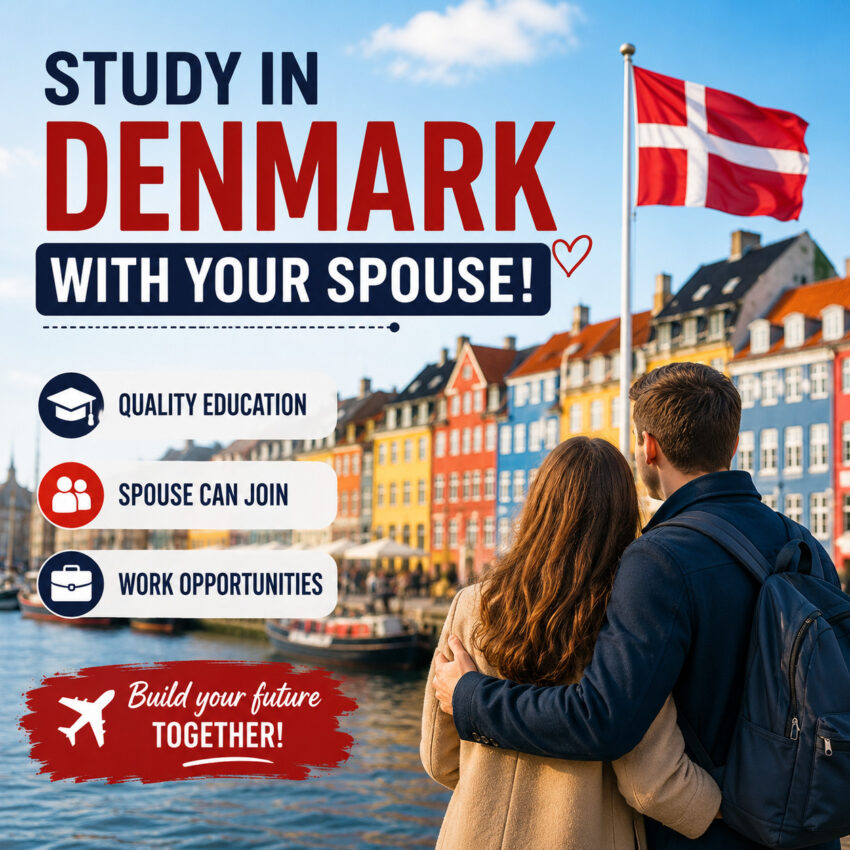
Planning to study in Europe but don’t want to leave your spouse behind? Denmark can be an interesting option for international students because eligible students enrolled in state-approved higher education programmes can bring their spouse or qualifying partner and children under 18. (Ny i Danmark)
However, Denmark has introduced important restrictions for students choosing non-state-approved programmes, so selecting the right institution and programme is extremely important.
Why Study in Denmark?


Denmark offers internationally recognised higher education and a wide selection of programmes taught in English. The official Study in Denmark portal currently lists more than 500 English-taught study programmes. (Study in Denmark)
International interest also remains strong. In 2026, more than 8,100 applicants with non-Danish citizenship applied for English-taught higher education programmes, while 2,065 international students were admitted through the coordinated admission system. (Study in Denmark)
Students can find programmes at different levels, including:
- Bachelor’s degrees
- Professional bachelor’s programmes
- Academy Profession programmes
- Master’s degrees
- PhD programmes
- Exchange programmes
- Selected arts programmes (Study in Denmark)
❤️ Can You Bring Your Spouse to Denmark While Studying?
Yes — but the type of programme matters.
If you are admitted to a state-approved higher education programme, your spouse, registered partner, cohabiting partner and children under 18 may generally apply for residence as accompanying family members. (Ny i Danmark)
This makes Denmark particularly interesting for married students who want to pursue their education without permanently separating from their family.
Eligible family members can include:
- 👩❤️👨 Spouse
- 💍 Registered/civil partner
- 🏠 Qualifying cohabiting partner
- 👶 Children under 18 living at home (Ny i Danmark)
⚠️ Important: State-Approved vs Non-State-Approved Programmes
This is one of the most important things applicants need to understand.
Since 2 May 2025, students applying for residence permits for non-state-approved higher education programmes generally cannot bring accompanying family members under the student route. (Ny i Danmark)
Therefore, before paying tuition or submitting an application, check whether your chosen programme is state-approved.
Don’t choose a programme based only on its university name or an agent’s recommendation. Check the programme and its immigration implications yourself.
🎓 Admission Requirements
You first need admission to an eligible Danish educational programme.
Requirements vary according to the university and programme, but applicants may need:
- Previous academic qualifications
- Transcripts
- Proof of English proficiency
- Programme-specific qualifications
- Passport
- Other documents requested by the institution
For English-taught programmes, Denmark generally requires a high level of English. The official Study in Denmark guidance states that programmes may require proficiency comparable to English B, while some require the higher English A level. IELTS, TOEFL and Cambridge examinations are among commonly used tests. (Study in Denmark)
💰 How Much Does It Cost to Study in Denmark?
Tuition depends on your nationality, institution and programme.
Students from outside the EU/EEA/Switzerland generally pay tuition fees. Study in Denmark gives an indicative annual tuition range of approximately:
€6,000–€16,000 per year
or roughly DKK 45,000–120,000 per year. Exact fees must be confirmed with the institution. (Study in Denmark)
You should also budget for:
- 🏠 Accommodation
- 🍎 Food
- 🚆 Transportation
- 📚 Study materials
- 📱 Daily expenses
- 🏥 Insurance and other personal costs
- 👨👩👧 Additional expenses if your spouse or children accompany you
💳 Financial Requirement for Students & Family
Financial documentation can be an important part of the residence process.
For 2026, SIRI uses DKK 7,426 per month as the relevant self-support amount in applicable cases. For an accompanying family member staying for 12 months, this can mean documentation of up to DKK 89,112 for that person. (Ny i Danmark)
The exact financial-documentation requirements depend on the circumstances, including whether tuition has been paid and whether scholarships or other qualifying support apply.
Always check the current SIRI requirements before submitting your application.
💼 Can Your Spouse Work in Denmark?
One of the major advantages of the accompanying-family route is that an accompanying family member of an eligible student can have the right to work in Denmark without needing a separate work permit in the normal case.
The accompanying family member may also have opportunities to study or run a business, subject to the applicable rules. (Ny i Danmark)
This can make the overall move more practical for couples because one partner can study while the other seeks employment.
👨🎓 Can the Student Work?
Eligible international students can also have limited work rights under the Danish student residence system.
However, the exact work rights depend on the type of programme and residence permit, so students should check the current SIRI conditions before relying on employment income to finance their studies.
🛂 Applying for the Residence Permit
After receiving admission, a non-EU/EEA student normally needs to apply for a Danish residence permit for studies.
The process is handled by the Danish Agency for International Recruitment and Integration (SIRI). (Ny i Danmark)
A typical process involves:
1. 🎓 Get admission
Apply to an eligible Danish higher education institution.
2. 📄 Prepare your documents
Prepare your passport, admission documentation, financial evidence and other required documents.
3. 🛂 Apply for the student residence permit
Submit the required residence application through the Danish immigration system.
4. ❤️ Apply for accompanying family
Your eligible spouse/partner and children can submit the relevant family applications.
SIRI currently lists the MF1 form as the application for an accompanying family member of someone who will work or study in Denmark. (Ny i Danmark)
5. 🇩🇰 Wait for processing
SIRI currently indicates a normal processing time of around 2 months for applications from accompanying family members to students, although cases can take longer. (Ny i Danmark)
🚨 Common Mistakes to Avoid
❌ Choosing a non-state-approved programme
This is potentially the biggest mistake for students planning to move with their spouse.
❌ Assuming every Danish programme allows family
The family benefit discussed in this article applies to eligible state-approved higher education programmes.
❌ Relying completely on an agent
Always verify immigration rules through official Danish government sources.
❌ Ignoring the total family budget
Tuition is only one part of the cost. Housing and everyday expenses for two people can significantly increase the required budget.
❌ Applying with incomplete documentation
Missing financial or educational documents can create delays or complications.
🌍 Is Denmark a Good Choice for Couples?
For the right applicant, yes.
Denmark combines English-taught education with a family-accompaniment route for eligible students. The ability for an accompanying spouse to have work rights can also make the move more attractive.
But this isn’t simply a “study visa + spouse” shortcut.
Your programme, institution, financial situation and immigration eligibility all matter.
📌 Denmark Study + Spouse: Quick Summary
| Question | Answer |
|---|---|
| Can international students study in Denmark? | ✅ Yes |
| Are English-taught programmes available? | ✅ Yes |
| Can a student bring a spouse? | ✅ For eligible state-approved programmes |
| Can children accompany the student? | ✅ Eligible children under 18 |
| Can an accompanying spouse work? | ✅ Generally yes |
| Do non-EU students usually pay tuition? | 💰 Yes |
| Can family accompany students in non-state-approved programmes? | ❌ Generally no for applications under the post-2 May 2025 rules |
| Should applicants check programme approval? | ⭐ Absolutely |
🔗 Official Resources
Study in Denmark — Official Government Portal
Study in Denmark
Find English-Taught Programmes
Study in Denmark Programme Portal
Danish Immigration — Higher Education
New to Denmark: Higher Education
Accompanying Family Members
New to Denmark: Accompanying Family
Tuition Fees
Study in Denmark: Tuition Fees & Scholarships
English Language Requirements
Study in Denmark: Language Requirements