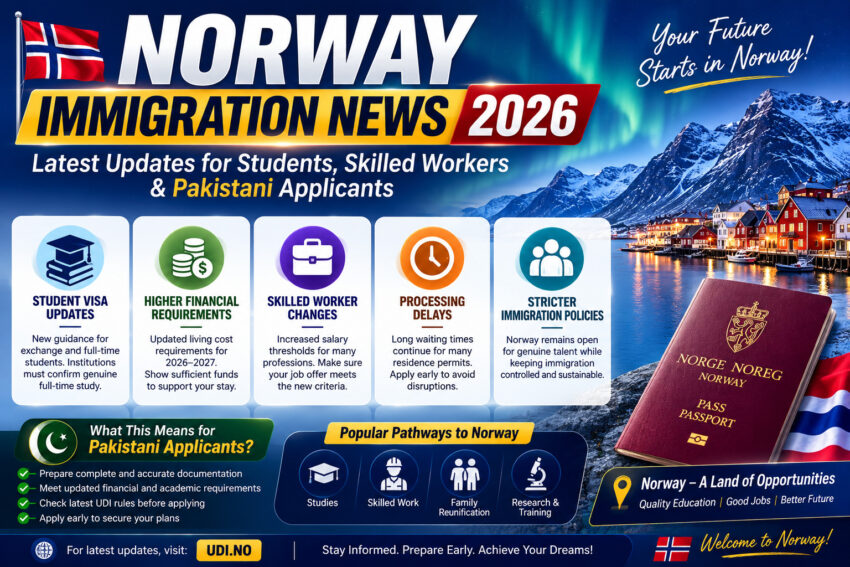

Norway has introduced several important immigration updates in 2026 that affect international students, skilled workers, and families planning to relocate. The Norwegian government continues to emphasize controlled immigration while improving digital services and updating residence permit rules. For Pakistani students and professionals, understanding these changes is essential before submitting a visa application. (UDI Regelverk)
Norway Immigration News 2026: Latest Updates for Students, Skilled Workers, and Pakistani Applicants
Norway remains one of Europe’s most attractive destinations for higher education and skilled employment. Known for its high quality of life, strong economy, and world-class universities, the country continues to welcome qualified international applicants. However, immigration policies are becoming more structured, with stricter documentation requirements and updated financial criteria.
Student Residence Permit Rules Updated
In July 2026, the Norwegian Directorate of Immigration (UDI) updated its guidance for student residence permits. One of the most significant changes affects exchange students who do not receive academic credits in Norway. Educational institutions must now confirm that these students are studying full-time, ensuring only genuine students qualify for residence permits.
The updated guidance also clarifies eligibility for exchange programmes and introduces new administrative procedures aimed at improving transparency. These changes are designed to strengthen the integrity of Norway’s international education system while supporting legitimate students. (UDI Regelverk)
Financial Requirements for International Students
Students applying for a Norwegian residence permit must continue to demonstrate sufficient financial resources to support themselves during their stay. UDI updates these financial requirements regularly to reflect living costs.
Applicants should ensure they have the required funds available before submitting their application, as insufficient financial documentation remains one of the most common reasons for delays or refusals. Processing guidance for the 2026–2027 academic year has also been updated to help students receive decisions before university programmes begin whenever applications are submitted on time. (UDI)
Skilled Workers Face Higher Salary Requirements
Norway has maintained higher salary thresholds for residence permits issued to skilled foreign workers. The government says the policy helps ensure foreign employees receive wages that match Norwegian labour market standards while preventing wage dumping.
Applicants seeking employment in engineering, healthcare, information technology, construction, and other skilled professions should verify that their employment contracts meet current salary requirements before applying. (Nairametrics)
Residence Permit Processing Delays Continue
Despite improvements in digital processing, many applicants continue to experience long waiting times for residence permits. Recent figures show thousands of family immigration and residence permit applications remain pending, with some applicants waiting well beyond one year.
UDI has acknowledged the backlog and says it is working to reduce waiting times through improved case management and additional resources. However, applicants are encouraged to apply as early as possible to avoid disruptions to travel, employment, or studies. (The Local Norway)
What These Changes Mean for Pakistani Applicants
Pakistani students continue to have excellent opportunities to study in Norway, particularly in fields such as engineering, renewable energy, computer science, and business. However, successful applications require careful preparation.
Applicants should:
- Secure admission to a recognised Norwegian institution.
- Prepare complete financial documentation.
- Ensure all academic and identity documents are accurate and translated where required.
- Apply well before university deadlines because of possible processing delays.
- Carefully review updated UDI requirements before submitting an application. (UDI Regelverk)
For Pakistani professionals, Norway continues to offer opportunities in sectors experiencing labour shortages. Meeting qualification requirements, obtaining a valid job offer, and satisfying salary thresholds remain the key requirements for obtaining a skilled worker residence permit. (Nairametrics)
Looking Ahead
Norway’s 2026 immigration updates reflect the government’s effort to balance economic needs with secure and well-managed migration. While the country remains open to talented international students and skilled professionals, applicants are expected to meet higher standards for documentation, financial stability, and eligibility.
Those planning to study, work, or reunite with family in Norway should monitor official UDI announcements and prepare applications carefully to maximize their chances of approval.