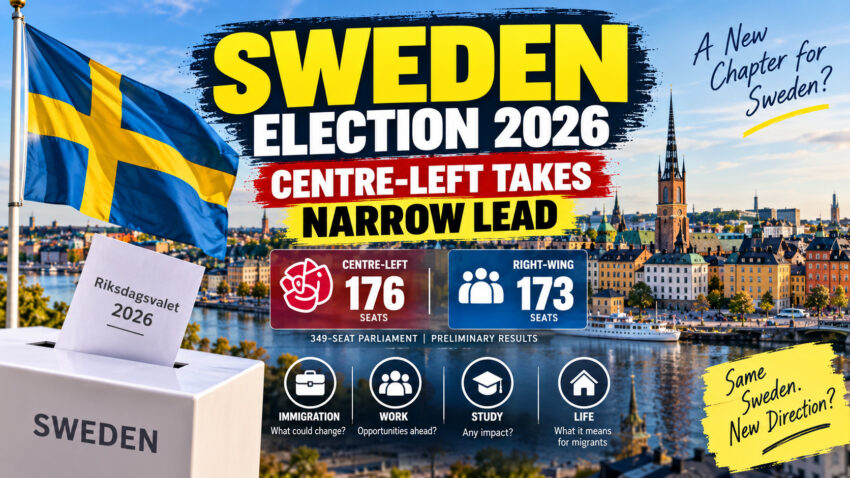

Sweden Election 2026: Centre-Left Takes Narrow Lead — What It Could Mean for Immigration
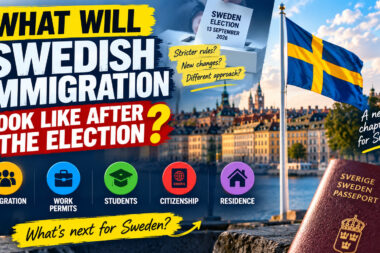
Sweden’s 2026 election has produced a dramatic result, with the centre-left opposition currently holding a narrow lead over the governing right-wing bloc.
Preliminary results show the centre-left bloc with 176 seats, compared with 173 seats for the right-wing bloc in Sweden’s 349-seat parliament. However, the result is not yet fully final, with remaining districts and overseas ballots still to be counted. (Reuters)
The result could have important consequences for Sweden’s political direction — particularly on immigration, integration, welfare and employment policies.
🗳️ What Happened in Sweden’s Election?
Swedes went to the polls on 13 September 2026 to elect members of the Riksdag, the country’s 349-seat parliament.
The preliminary count puts the centre-left opposition, led by the Social Democrats, ahead of the current right-wing governing bloc.
Current preliminary picture:
Centre-left bloc: 176 seats
🔵 Right-wing bloc: 173 seats
🏛️ Parliament: 349 seats
The difference is only three seats, meaning the political situation remains extremely close. Final results are expected after additional votes, including overseas ballots, are counted. (Reuters)
👩💼 Magdalena Andersson Could Return as Prime Minister
The centre-left opposition is led by Social Democrat Magdalena Andersson, who previously served as Sweden’s prime minister.
If the preliminary result holds and the opposition can successfully form a government, Andersson could return to the country’s top political position.
However, forming a government may not be straightforward.
The centre-left bloc contains several parties with different positions on taxation, nuclear energy, economic policy and immigration. (Reuters)
This means Sweden could face negotiations before a new government is formally established.
🚨 What Does This Mean for Immigration?
Immigration was one of the important issues surrounding the election.
Sweden has moved significantly toward stricter immigration policies in recent years. The current government has introduced tougher rules affecting refugees, welfare access and deportations.
Interestingly, even the centre-left Social Democrats have adopted a considerably more restrictive position on immigration than they did during the refugee crisis of the 2010s. (Reuters)
So, will Sweden suddenly become easier for migrants?
Probably not.
Analysts quoted by Reuters say that a centre-left government could take a somewhat different approach, but a major return to Sweden’s previous open-door immigration policies is unlikely. (Reuters)
For migrants, this is an important distinction.
A change of government does not automatically mean easier visas, easier asylum procedures or fewer immigration requirements.
📉 Sweden Democrats Lose Ground
One of the biggest developments was the performance of the Sweden Democrats, the anti-immigration party that has supported the current government from outside the cabinet.
Preliminary projections indicate that the party could lose around 11 parliamentary seats, marking its first decline in a national parliamentary election. (Reuters)
The result is significant because the Sweden Democrats had become an increasingly influential force in Swedish politics and played an important role in the government’s immigration agenda.
🌍 What Could Change for Foreign Workers?
For people considering Sweden for work, the election could eventually affect:
- 👷 Work immigration
- 💼 Labour-market policies
- 🏠 Residence requirements
- 👨👩👧 Family reunification
- 🧾 Permanent residence rules
- 🇸🇪 Citizenship and integration policies
But nothing changes immediately simply because of the election result.
Existing immigration laws remain in force unless a new government and parliament introduce and approve changes.
Therefore, people planning to work or study in Sweden should continue following the current official rules rather than assuming that the election will immediately make immigration easier or harder.
🎓 What About International Students?
Sweden remains an important destination for international students, particularly in fields such as:
💻 Technology
🔬 Engineering
🏥 Healthcare
📊 Business
🌱 Sustainability
🎓 Research
Any future changes to immigration or residence rules could affect international students who want to remain in Sweden after graduation.
However, there is currently no basis to say that student immigration rules have changed because of the election.
Students should continue following the Swedish Migration Agency’s current requirements until any new legislation is officially announced.
Could Sweden Change Its Immigration Direction?
The election creates an interesting situation.
On one side, the centre-left has gained the advantage.
On the other, Sweden’s political debate has already shifted toward stricter immigration policies.
That means the most likely scenario is not a complete reversal, but potentially a change in emphasis.
The next government could focus more heavily on:
- Integration
- Employment
- Welfare
- Social cohesion
- Education
- Crime prevention
while maintaining significant restrictions on immigration.
Reuters reports that analysts expect Sweden’s broader move toward stricter migration policy to remain largely in place. (Reuters)
⏳ The Result Is Not Completely Final Yet
This is important for anyone sharing the news.
The 176–173 result is preliminary.
Votes are still being processed, including overseas ballots, and party leaders have been cautious about declaring a definitive victory. (Reuters)
So the correct headline for now is:
“Sweden’s Centre-Left Takes Narrow Lead in 2026 Election”
rather than:
❌ “Sweden Has a New Government”
The government formation process still has to take place.
What Should Migrants Watch Next?
The most important developments over the coming days and weeks will be:
1️⃣ Who forms the next government?
The centre-left parties will need to work out how they can govern together.
2️⃣ Will immigration policy change?
Watch for announcements concerning residence permits, asylum, family reunification and citizenship.
3️⃣ What happens to work immigration?
Foreign workers should watch for any changes affecting employment-based residence permits.
4️⃣ Will integration requirements increase?
Language, employment and integration policies could become an important part of the new government’s agenda.
5️⃣ Will Sweden maintain its tougher migration approach?
This may be one of the biggest questions for migrants following the election.
Sweden’s Election Could Matter Beyond Politics
For international students, workers and migrants, Sweden’s election is more than a political story.
The country’s approach to immigration, employment, residence and integration has changed considerably over recent years.
The centre-left’s narrow lead could therefore influence Sweden’s future direction — but it does not mean that immigration rules have changed overnight.
For now, migrants should wait for the final election result and any official policy announcements before making decisions based on the election.
TravellerTrek will continue following Sweden’s immigration and travel developments.