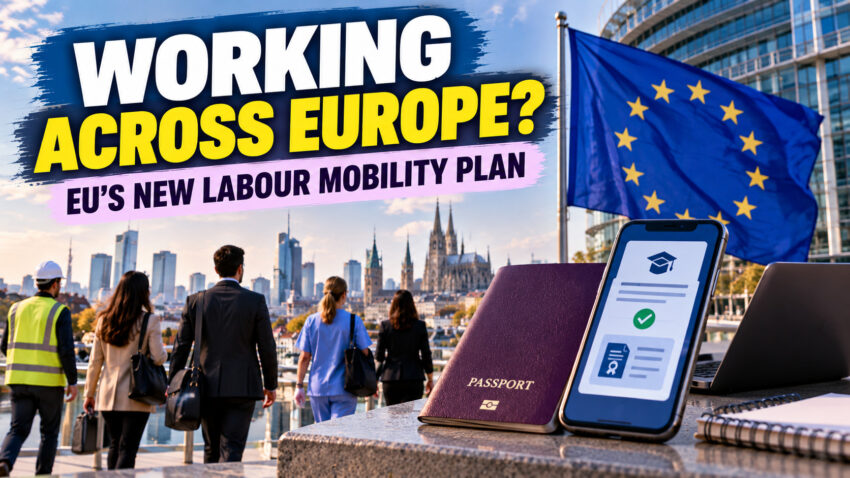

Europe’s New Fair Labour Mobility Plan: Could It Become Easier to Work Across Europe?
Published: 19 October 2026
Introduction
Finding a job in Europe is only one part of building a career abroad. Workers may also need their qualifications recognised, prove their social security status, and navigate administrative procedures that differ between countries.
On 15 September 2026, the European Commission announced a new Fair Labour Mobility package designed to make it easier for people to move between EU countries for work, demonstrate their professional skills and access relevant social security documents.
The package proposes digital documents, more straightforward qualification comparisons and stronger cooperation between national authorities. It could eventually reduce some of the administrative barriers faced by mobile workers and employers.
But what does this mean for people hoping to work in Europe, particularly international applicants from countries such as Pakistan?
Here is what the proposal includes, what still needs to happen and what job seekers should understand before making plans.
1. What Is the EU’s Fair Labour Mobility Package?
The Fair Labour Mobility package is a set of proposals introduced by the European Commission to improve how workers’ rights, qualifications and social security information are handled across EU countries.
At present, someone who moves to another EU country for work may need to provide documents, obtain recognition of professional qualifications or deal with different national administrative procedures.
The Commission wants to make some of these processes more consistent, secure and accessible.
The package includes proposals concerning:
- A European Social Security Pass.
- Digital and comparable professional qualifications.
- Updated rules for recognising certain professional qualifications.
- Recognition procedures for qualifications obtained outside the EU.
- Stronger powers and cooperation for the European Labour Authority.
The overall objective is to make cross-border employment easier to administer while improving protections against abuse and unfair employment practices.
Important: The Commission has announced a package of proposals. The proposed measures should not be treated as if every new procedure is already available to workers.
2. Could Digital Qualifications Make It Easier to Find Work?
One of the main elements is the proposed Skills Portability Act.
Professional qualifications can be difficult for employers to compare when they have been issued under different national education and training systems. An employer may need to determine what a certificate represents, whether it is genuine and whether it meets the requirements of a particular position.
The Commission proposes to make qualifications easier to issue, verify and compare through standardised digital formats and a new qualification-comparison tool.
How could this help workers?
A more consistent system could help employers understand applicants’ qualifications and reduce some of the paperwork involved in recruitment.
For example:
- An engineer applying for a position in another EU country could benefit from clearer comparisons of qualifications.
- A technician could have an easier way to demonstrate the authenticity of a certificate.
- An employer could use more consistent information when evaluating applicants educated in another country.
However, a digital qualification does not automatically give someone permission to work in every EU country.
Certain professions are regulated and require formal recognition, registration or other authorisation. Employers may also require relevant experience, language skills and additional professional documents.
The proposed system is intended to make relevant processes easier, not remove every professional requirement.
3. What Is the European Social Security Pass?
Another important component is the proposed European Social Security Pass, known as ESSPASS.
Social security documents can be important when people work across borders. They may help establish which country’s social security system applies or demonstrate eligibility for particular benefits.
Under the proposal, people and businesses would be able to request, receive and present relevant documents digitally.
The documents covered are expected to include:
- The European Health Insurance Card.
- Portable Document A1 for posted workers.
- Other relevant social security documents introduced through the planned system.
The proposal also envisages using the EU Digital Identity Wallet to store and present documents, allowing authorities to verify them more efficiently.
Why does this matter?
Digital access could reduce the need to manage paper documents and make certain administrative checks quicker.
For workers who move between EU countries, that could mean a simpler way to provide information when required.
However, the Social Security Pass is not a job offer, work permit or residence permit. It should not be confused with permission to enter or work in a country.
Its purpose is to help people demonstrate relevant social security rights and information.
4. What About People With Qualifications From Outside the EU?
This is particularly relevant to international job seekers.
The Commission’s package includes a proposal to improve how qualifications obtained outside the EU are recognised in relevant circumstances.
This matters because an applicant educated in a non-EU country may need to demonstrate how their qualifications compare with the requirements of a European employer or professional regulator.
Under the proposed approach, recognition procedures could become more consistent and easier to navigate.
Could Pakistani graduates benefit?
Potentially, yes—but the outcome would depend on the final rules and the occupation involved.
A Pakistani graduate applying for a job in Europe should not assume that a degree will automatically be accepted simply because the EU has proposed changes.
Applicants should still check:
- Whether the profession is regulated in their destination country.
- Whether their degree or professional certificate must be formally recognised.
- Whether certified translations or additional documents are required.
- Whether the employer requires a particular level of experience.
- Whether they meet the destination country’s immigration and work authorisation requirements.
For example, a software developer and a regulated healthcare professional may face very different recognition requirements.
The proposed package may help simplify some processes, but it does not establish a universal recognition system that automatically validates every foreign qualification.
5. Will This Make It Easier to Get a European Work Visa?
This is one of the most important questions for people hoping to relocate.
The short answer is that the package is not a new EU-wide work visa scheme.
The proposals primarily address labour mobility, social security documentation, professional qualifications and enforcement of workers’ rights.
A person applying for employment in an EU country may still need to meet that country’s immigration requirements, including any applicable work permit or residence permit conditions.
Depending on the country and route, applicants may also need:
- A qualifying job offer.
- Evidence of professional qualifications.
- Relevant work experience.
- Proof of salary or other employment conditions.
- Language skills where required.
- A valid passport and supporting immigration documents.
The rules vary by country and immigration route.
For example, an applicant considering Germany should check Germany’s official immigration guidance rather than assume that an EU-wide labour mobility proposal replaces German work authorisation requirements.
The same principle applies to France, Italy, Spain, Portugal and other EU destinations.
6. Will Employers Find It Easier to Recruit International Workers?
The Commission also wants to reduce administrative barriers that can make cross-border recruitment more difficult.
Businesses may need to verify qualifications, understand social security obligations and coordinate with authorities when employing workers across borders.
The proposed measures aim to make some of these tasks more efficient.
Potential benefits could include:
- Easier verification of professional documents.
- Better comparisons of qualifications.
- More efficient handling of relevant social security information.
- Stronger cooperation between national enforcement authorities.
- Better protection against fraudulent or abusive employment practices.
Small and medium-sized businesses could benefit if administrative processes become simpler.
However, these are intended benefits, not a guarantee that every employer will immediately recruit more foreign workers or that vacancies will become available to every applicant.
Recruitment will continue to depend on business needs, qualifications, labour-market conditions and national employment and immigration rules.
7. How Will the EU Strengthen Worker Protection?
The package also proposes a stronger role for the European Labour Authority.
The authority supports cooperation between EU countries on labour mobility and the enforcement of relevant employment rules.
The Commission proposes giving it stronger tools to support inspections, improve cooperation and help address cross-border disputes and abuse.
This is important because workers who move between countries may find it difficult to understand which authority to contact or how to resolve a problem involving an employer in another jurisdiction.
Stronger cooperation could help authorities identify non-compliance and protect workers more effectively.
For international applicants, this is also a reminder to verify recruitment offers carefully. No policy proposal removes the need to check whether an employer, recruiter or immigration adviser is legitimate.
8. When Could the Proposed Changes Take Effect?
The package was announced on 15 September 2026. The proposals must proceed through the relevant EU legislative process before the measures that require legislation can take effect.
The Commission has outlined a phased approach.
Its published information indicates that:
- The first practical benefits depend on adoption of the initiatives and the relevant measures entering into force.
- Digitalisation of social security documents is planned in stages.
- Changes involving qualifications and skills portability are also expected to be phased in.
- Improvements to the European Labour Authority’s work are dependent on the relevant changes being adopted.
The Commission has outlined implementation periods of approximately two to three years after adoption for certain qualification measures, with further improvements to the European Labour Authority expected over 2028–2030.
These are planned timelines, not a promise that every feature will be available on a specific date. The actual timetable will depend on the legislative process and implementation.
9. What Should International Job Seekers Do Now?
People who want to work in Europe do not need to wait for the entire package to be implemented before preparing their applications.
There are several useful steps they can take now.
Prepare your documents
Keep your educational certificates, transcripts, employment references and professional licences organised. Obtain translations or verification when required by the relevant authority.
Research the destination country
Choose a country and identify the immigration route that matches your circumstances. Check the requirements on official government websites.
Check professional recognition requirements
If your occupation is regulated, contact the relevant national authority to learn whether your qualifications need formal recognition.
Apply through verified channels
Use legitimate employer websites and established recruitment platforms. Be cautious of anyone promising a guaranteed visa or job in exchange for a large upfront payment.
Follow official updates
As the Fair Labour Mobility package progresses, check whether the proposals relevant to your occupation have been adopted and when they will become operational.
These steps can help applicants prepare without relying on proposed changes that may not yet be available.
Frequently Asked Questions
1. What is the EU Fair Labour Mobility package?
It is a package announced by the European Commission on 15 September 2026. It proposes measures to simplify certain cross-border employment procedures, improve qualification recognition, digitalise social security documents and strengthen worker protection.
2. Is the package already fully in force?
No. The package contains legislative proposals that must proceed through the relevant EU process. Implementation will be phased, and the timing depends on adoption and the measures entering into force.
3. Can Pakistani citizens use the proposed qualification system?
The package includes proposals concerning qualifications obtained outside the EU. Whether a particular applicant can benefit will depend on the final rules, their occupation and the destination country’s requirements.
4. Does the package guarantee a job in Europe?
No. It does not guarantee employment, a job offer, a work permit or a visa. Applicants must continue to meet relevant employer and immigration requirements.
5. Will every foreign degree be recognised automatically?
No. Recognition depends on the occupation, the applicable national rules and the final implementation of the proposals. Regulated professions may have additional requirements.
6. What is ESSPASS?
ESSPASS is the proposed European Social Security Pass. It is intended to make relevant social security documents easier to request, receive, store and present digitally.
7. Where can I find reliable updates?
Start with the European Commission’s official announcement and its Fair Labour Mobility package page, linked below.
Conclusion
The European Commission’s Fair Labour Mobility package could make certain aspects of working across EU countries easier by improving digital documentation, qualification comparisons and cooperation between authorities.
For international job seekers, the proposed changes are worth following—particularly if their qualifications need to be evaluated by European employers or professional regulators.
However, the package should not be mistaken for a new work visa or a guarantee of employment. Applicants must still check the requirements that apply to their destination country and occupation.
The best approach is to prepare your documents, research official work routes and follow the legislative developments as they progress.
TravellerTrek will continue to explain European travel, employment and immigration developments so readers can make informed decisions.
Official Sources
- European Commission — Commission proposes ambitious measures to strengthen fair labour mobility
- European Commission — Fair Labour Mobility Package
- European Commission — Guaranteeing social rights for workers everywhere in the EU
Disclaimer: This article is for informational purposes only. It is not legal, immigration or employment advice. Proposed measures may change during the legislative process. Always verify current requirements with the relevant official authorities.